
Artificial
Intelligence
Reliable AI Solutions Thanks to Measurable Quality. Real Added Value Instead of Endless Prototypes
Artificial Intelligence in Software Development: What Really Matters?
Artificial intelligence is no longer just a topic for the future. The key question is not whether AI will be used, but whether an AI solution reliable enough for productive operation. Pilot projects often seem promising, but they remain uncertain or unreliable.
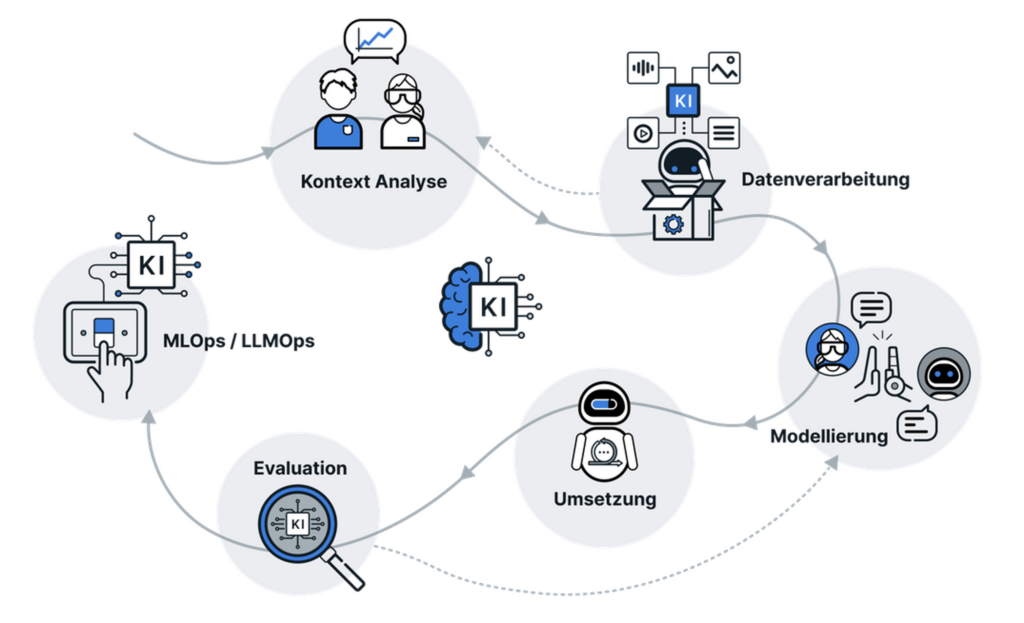
We have been developing custom software for over 25 years and combine the security and quality standards of traditional software development with the measurable quality of AI components. Our AI division supports companies from the very beginning Use Case Evaluation up to the Implementation Productive AI Solutions – from traditional machine learning to large language models to agent-based AI.

An Overview of Our Services
Our Services and Case Studies in Artificial Intelligence
- AI Consulting and Workshops,
- Implementations,
- AI-powered data classification,
- AI Document Management,
- AI-based process automation,
- AI agents,
- Machine Learning,
- LLMs

Artificial Intelligence Consulting
Sustainable know-how transfer for your company thanks to our AI consulting: workshops, use case evaluation, implementation consulting …

AI Document Management
LLM-Based Document Analysis and Processing in Healthcare …

AI-powered Data Classification
Automated Classification of Structured Datasets in the Public Sector …

AI-Based Process Automation
AI-based process automation for corporate data sets and data mapping in the public sector …
What types of artificial intelligence are currently available?
Artificial intelligence is an umbrella term for a wide variety of technologies. In practice, this distinction is crucial, because each technology has its own strengths, costs, and quality requirements. Our guiding principle is: Where a traditional software solution is sufficient, it is the better choice. Machine learning, then LLM.

Classical Machine Learning
A model learns to recognize patterns and classify cases based on historical data. The process follows a set pattern: data collection and data engineering, model selection and training configuration, training using frameworks such as TensorFlow or scikit-learn, followed by evaluation and deployment.
Methods such as XGBoost often deliver better results than large language models in classification tasks — at a fraction of the cost and with decision times in the millisecond range.
Large Language Models (LLMs)
A large language model first breaks text down into tokens and converts them into vectors. Based on this, the model predicts the next token—which gives it the ability to understand and generate language.
When putting these models into use, the question of architecture arises early on: cloud APIs from proprietary providers such as OpenAI, Google, or Anthropic, billed per token — or self-hosted open-weight models such as Qwen, GLM, DeepSeek, or Mistral, run via frameworks like vLLM or Ollama. The latter requires GPU hardware but keeps sensitive data on-premises.
Chatbots and Assistant Systems
The classic among LLM applications—and more technically challenging than it appears. LLMs are stateless: The message history must be stored in the application and provided with every request.
Since the context is limited, strategies are needed to shorten long conversations. Guardrails prevent unintended input and output, while rate limits and cost tracking protect against unexpected bills when using cloud APIs.
04
Retrieval-Augmented Generation (RAG)
RAG combines a language model with your own knowledge. During the ingestion process, the knowledge base is broken down into chunks, converted into vectors, and stored in a vector database such as Chroma, Milvus, or PG-Vector. When a query is made, the most relevant chunks are identified and provided to the model.
A functional retrieval system can be built quickly—but a very good one requires techniques such as re-ranking, hybrid search combining semantic and keyword search, or graph-based and agentic RAG.
05
AI Workflows
For more complex tasks, the problem is broken down into clearly defined individual steps, each with specified inputs and outputs. Individual steps can be deterministic or AI-based, allowing them to be optimized and evaluated separately.
LLM steps typically use structured JSON output as the basis for the next step—so error handling is necessary, such as retries in the event of invalid JSON. This is implemented using frameworks like LangGraph or tools like n8n and Camunda AI.
06
AI Agents
Agents are autonomous, iterative AI programs that independently use tools—ranging from database queries to web searches to API calls. Because an agent gathers more context with each iteration, context engineering is key to achieving good results.
In addition, protection against prompt injection and unintended tool invocations is needed, as well as robust error handling. AI agents are the foundation for AI’s disruptive impact on software development.

What Sets AI Software Apart from Traditional Software
The key difference is non-determinism: AI components operate probabilistically. 100 % Correctness can never be guaranteed with an AI model—unlike with traditional software, which always produces the same result for the same input. This is not a flaw, but rather a characteristic that the architecture must account for.
At the same time, it’s important to note that manual processes are not error-free either. In one of our public-sector projects, the error rate for manual processing to date was 3 %—despite the dual-review principle. The right question, therefore, is not whether an AI solution is error-free, but whether it is measurably better than the existing process.
AI Measurability: How We Make the Quality of AI Solutions Measurable
01
Evaluation Against Ground Truth
Manual decisions made in the past serve as the basis for evaluation. In a classification project in the public sector, we used this approach to iteratively improve accuracy from approximately 93 % to 99.5 %—the model configuration was consistently data-driven, not based on intuition.
02
LLM as a Judge
When there is no single correct answer—such as in summaries—sample responses provided by subject matter experts are compared with the generated results and evaluated by another language model. This allows models and prompts to be selected based on facts rather than subjective impressions.
03
Each substep is evaluated separately
In an AI-powered document management system for the healthcare sector, we evaluated and optimized text recognition, summarization, and information extraction individually. For the OCR stage, ground truths from representative PDFs were automatically compared with the recognition results, and the models were optimized for the specific use case.
04
Evaluate retrieval separately from the answer
With RAG solutions, we evaluate the search independently of the generated response: Hit Rate and Recall indicate whether the correct sources were found; Precision indicates the proportion of relevant hits; and Mean Reciprocal Rank indicates the position of the correct sources in the results.
05
Monitoring During Live Operation
After the go-live, measurements will continue to be taken systematically. In an agent-based assignment solution in the public sector, every AI decision is reviewed by a human, and the correction rate is recorded and made available—this ensures that quality remains visible over the long term and that human oversight is maintained.
06
Observability and LLMOps
Traceability of every input and output along the processing chain is a prerequisite for optimization. In addition to traditional DevOps, MLOps and LLMOps therefore require observability of AI components and continuous data collection.
„Artificial intelligence delivers real added value for your company when the security and quality standards of conventional software are combined with measurable quality improvements achieved through AI elements.“
Dr. Danny Hucke
AI Lead and Research Specialist at IT Sonix
AI in Our Work
How We Use Artificial Intelligence
While others focus on shortening implementation time, AI-powered deployment is firmly integrated into our daily workflow. For our customers, this means measurable business benefits—not just faster programming: shorter release cycles, lower rework costs, and less technical debt.
For us, AI agents are standard tools, not experiments—they are integrated into coding guidelines that specify where AI provides support and where human review remains mandatory.

What this means for your project
Faster Time to Market Through AI-powered development from requirements to release, Lower project risks through early, functional prototypes instead of lengthy concept phases; faster validation of product design with reliable user feedback; operational efficiency through automated reviews, testing, and documentation; shorter release cycles and lower rework costs; Reduction of technical debt through consistent, automated quality assurance
Rapid Prototyping with AI
The most expensive part of a software project is the decision that later turns out to be wrong. Rapid prototyping with AI shortens precisely the phase in which such decisions are made: Instead of spending weeks specifying requirements, a working prototype is created within days, allowing assumptions to be tested.
McKinsey estimates the Generative AI reduces development and testing time by 30 to 50 percent; Companies that translate requirements directly into prototypes report cycles from requirement to prototype that are about 45 percent faster and significantly fewer misunderstandings between business units and development. For them, it’s not so much the speed itself that matters as what it enables: more vetted options before the budget is committed to a single direction.

Pre-built AI setups for a faster project launch
We’re not starting from scratch. For recurring task patterns—RAG applications, classification, document processing, and agents with tool access—we offer preconfigured setups: Project framework, integration with cloud and OpenWeight models, vector database, evaluation framework, and observability are all in place and proven.
This shifts the project kickoff from infrastructure work directly to your specific use case. The setups are intentionally kept technology-agnostic so that the choice between cloud API and on-premises operation remains a business decision rather than a consequence of tool selection.
AI Agents as a Standard Tool
In our development teams, AI agents are standard tools—for code generation, refactoring, test creation, and research in existing codebases.
The benefit lies not in typing faster, but in the ability to explore scenarios that previously lacked the time to consider. The framework remains crucial: what an agent is allowed to do is defined in coding guidelines, and every change undergoes the same quality assurance process as manually written code.
Automated AI Reviews
Every pull request is automatically checked before a human reviews it—for security patterns, consistency with project conventions, missing tests, and common error types.
Whereas a review used to sit in the queue for hours or days, feedback is now available within seconds; industry analyses show that this results in 30 to 50 percent shorter turnaround times for pull requests. The economic benefit stems less from the time saved on reviews than from the fact that errors are caught while they can still be fixed cost-effectively. Human reviews are not eliminated—they simply begin at a higher level.
Working with AI in Compliance with Data Protection Regulations
As of August 2, 2026, the transparency requirements of the EU AI Act will apply directly—AI-generated content and AI-powered dialogue systems must be identifiable as such. Anyone building an AI solution today should know its classification before the architecture is finalized.
When processing personal data or data requiring special protection, we use Open-Weight models on-premises—the data never leaves the company, eliminating the need for data processing by external model providers. Where cloud APIs are appropriate, we clarify the processing location, retention periods, and training exclusions before the first request. In addition, we ensure the traceability of every AI decision through observability and documented evaluation results—both of which are prerequisites for demonstrating compliance at a later date.

Frequently Asked Questions
How can I tell if artificial intelligence is worth it for my specific use case?
Two questions are crucial: Is there a recurring process that involves a significant amount of manual work—and is data from previous processing available? Where inputs and results are documented, the benefits of an AI solution can be estimated in advance and measured later. If such data is missing, collecting it is usually the first sensible step. In our use-case evaluation, we examine this together and estimate the required time, hardware, and personnel.
How much does an AI solution cost?
The range is considerable and depends on the approach. In our projects, implementation costs ranged from approximately 18,000 EUR for invoice workflow automation to around 125,000 EUR for complex complaint handling—with ongoing costs ranging from 0 to around 2,000 EUR per month. The key factor in determining cost-effectiveness is a comparison with the previous process: In the cases mentioned, annual operating costs ranged from 200,000 to 600,000 EUR. It should also be noted that LLM calls can become expensive in operation, and on-premises solutions require hardware investments.
Can an AI solution operate without errors?
No—and that is the most important expectation that needs to be clarified early on. AI components operate probabilistically; 100 % accuracy cannot be guaranteed. The appropriate benchmark is the existing process: In one of our projects, the error rate for manual processing was 3 % despite the dual-review principle; the AI solution achieved 97.5 % accuracy while still undergoing human review. The key point is that quality is measurable and monitored during operation.
Does our data remain within the company when using an AI solution?
This is an architectural decision made at the outset. Cloud APIs from proprietary providers are readily available and billed on a per-token basis. Where data must not leave the premises, we use open-weight models on-premises—this requires GPU hardware but keeps full control within the company. For a client in the healthcare sector, we operated a document management system entirely on-premises, using deliberately limited hardware resources.
How quickly can we get a first working solution?
With pre-built AI setups, an initial prototype is typically created within a few days to weeks, because the project framework, model integration, and evaluation framework are already in place. The prototype is specifically intended to test assumptions—not as a precursor to the production system. The measured results determine whether and how the project proceeds.
Do we need to develop our own AI expertise?
It’s not mandatory—but it helps a lot. Our workshop series is designed precisely for this purpose: In the fundamentals workshop, participants develop a shared understanding of AI, ML, and LLMs, and in the use-case evaluation workshop, your teams learn to evaluate use cases and metrics on their own. The goal is for you to be able to operate and further develop AI solutions independently.
We'd be happy to advise you

Dr. Danny Hucke
We understand that every project is unique. Dr. Danny Hucke looks forward to speaking with you to find customized solutions.
