








Industry-Specific Services
Predictive Maintenance
For Industry
Prevent Outages Before They Occur
Our Predictive Maintenance Software Systems
With predictive maintenance, you can make your machines, equipment, vehicles, storage systems, and production lines predictable based on data. Instead of relying on fixed maintenance intervals or reactive repairs, you can detect wear, anomalies, and impending failures early on and take targeted action to prevent unplanned downtime, maximize equipment availability, and save time and money.
Our Case Studies in Predictive Maintenance
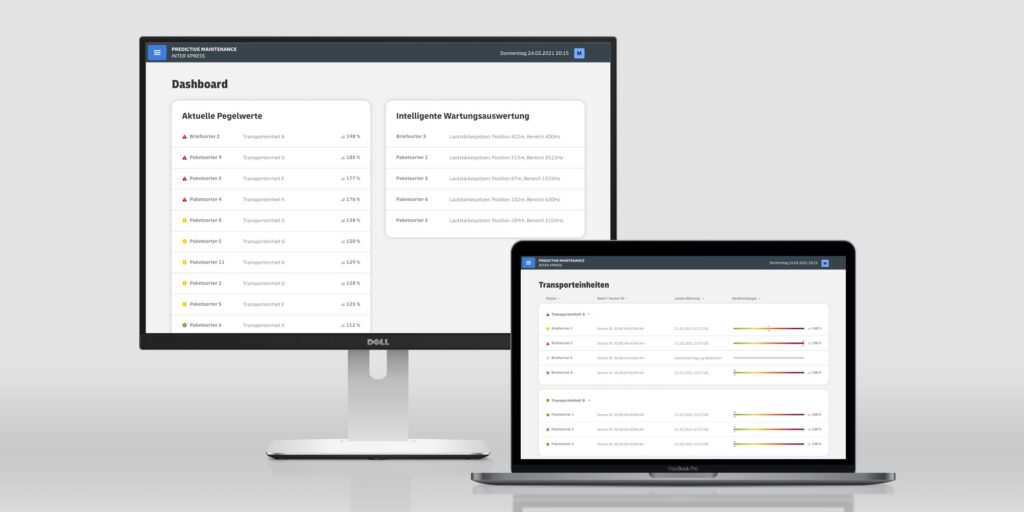
AI-driven predictive maintenance, predictive maintenance for industrial conveyor belts, Maintenance 4.0, and much more.
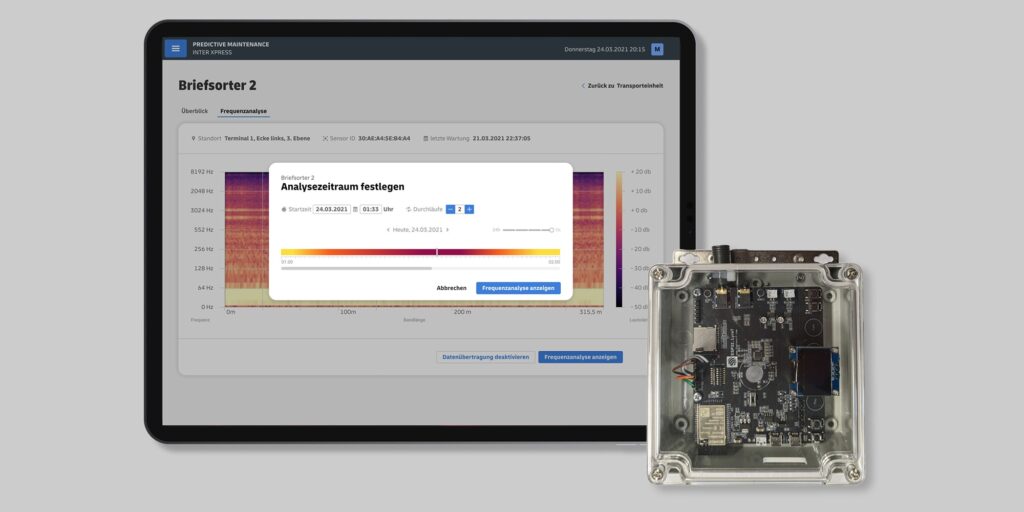
Predictive Maintenance for Industrial Belts
AI-Driven Predictive Maintenance for Energy Storage Systems
AI-powered failure prediction for energy storage systems in the field — developed, trained, and deployed in live operations. …
What is Predictive Maintenance?
Predictive maintenance refers to a proactive maintenance approach in which the condition of your machines, vehicles, or other equipment is continuously monitored and evaluated using data analysis.
To this end, sensors measure, for example, vibrations, temperature, pressure, or current consumption, which are then analyzed by analytics and monitoring systems. The specific data that is measured and analyzed varies from device to device.
The clear advantage lies in precision: Maintenance is no longer performed on a scheduled basis, but rather when the actual condition of a system requires it.
This reduces unplanned downtime, prevents unnecessary maintenance calls, and extends the service life of your equipment.
How Predictive Maintenance Solutions That Help Our Customers
How Are Predictive Maintenance Systems Developed?
Development steps for your project:
01
Maintenance Objectives and Data Sources
The first steps involve selecting the relevant machines, defining maintenance objectives, and identifying suitable data sources from sensors, control systems, and IT systems.
02
Data Pipeline Development
The first steps involve selecting the relevant machines, defining maintenance objectives, and identifying suitable data sources from sensors, control systems, and IT systems.
03
Model Development
This then leads to the development of rules, statistical models, or machine learning models that evaluate conditions, estimate remaining service life, or prioritize maintenance needs.
04
Integration into the IT and system landscape
In practice, integration with existing systems—such as MES, SCADA, ERP, or CMMS environments—is particularly important. For industrial use, it is not only the model that matters, but also its integration into existing processes, dashboards, alerts, and workflows.
Current Topics
White Paper
Digital Readiness Check for Fleet Operators: “How Data- and AI-Ready Is Your Fleet?”
We classify digital maturity along three dimensions – system compatibility, cost efficiency, and the proportion of standard and custom solutions….
Success Story
AI-Based Maintenance System for Energy Storage Systems
A neural network, trained on real-world data from more than 75,000 energy storage systems, identifies devices in the field that require maintenance before they fail. The project also included the handover of infrastructure to SENEC.
Blog Post
ZAP – The Security Tool Put to the Test by Experts
Success Story
MAN Cloud Platform for Fleet Management
We developed MAN's cloud-based RIO platform and MAN DigitalServices, an open ecosystem that digitally connects fleet management, dispatching, and driver training…
White Paper
Energy Systems: Off-the-Shelf Software vs. Custom Solutions
We'll show you where SAP's standard solutions are sufficient, and where customized solutions are the better fit for the energy transition….
What role does AI play in predictive maintenance?
AI makes predictive maintenance more scalable and precise. Machine learning models identify patterns in large, heterogeneous data sets that would be too complex for manual analysis, enabling them to assess anomalies, failure probabilities, or remaining service life more reliably. AI is particularly effective when combining multiple data sources, such as sensor readings, operating conditions, production data, and historical maintenance records. This results in robust predictions and maintenance recommendations that are based on the actual usage of the equipment.
Maintenance 4.0: Our Development Approach for Your State-of-the-Art Solution
Most architectural approaches to predictive maintenance in Industry 4.0 are based on RAMI 4.0 and distinguish between assets, communication and information layers, and integration into operational and maintenance processes. Typical components include:
- Edge or IoT layer for data collection at the machine.
- Data platform or cloud layer for storage, processing, and archiving.
- Analytics and AI layer for models, scoring, and forecasts.
- Application layer for dashboards, alerts, and maintenance planning.
Modular architectures are particularly well-suited for Industry 4.0 scenarios because machine fleets, data sources, and use cases often vary.
Your Questions, Our Answers:
For which machines and systems is predictive maintenance particularly suitable?
Particularly well-suited for critical equipment with high downtime costs, such as production machinery, pumps, motors, compressors, or conveyor systems.
How long does the implementation take?
A pilot project can often be completed in a matter of weeks or months. A full implementation takes longer, depending on the data available and the system environment.
Is predictive maintenance also worthwhile for medium-sized companies?
Yes, especially when downtime is costly or individual systems are mission-critical. A small, targeted rollout usually makes sense.
What are the ongoing costs?
Typical costs include operating expenses, data infrastructure, software maintenance, model updates, and support. The total cost depends heavily on the scope of the project and the effort required for integration.
Get Started on Your Project
Sebastian Wetzel
We understand that every project is unique. Our experts look forward to speaking with you to find customized solutions.
