
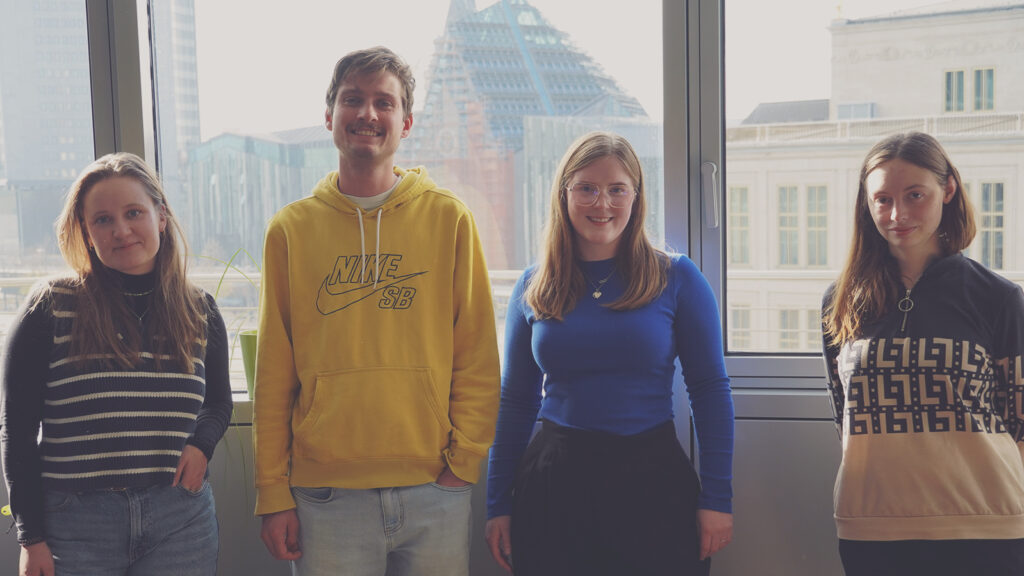
In the first part of our series, our working students Anton and Josi shared some fascinating insights into their day-to-day work at IT Sonix. In this part, we’ll introduce two more working students who demonstrate just how varied the work here can be.
As working students, they are fully integrated into their teams from the very beginning and benefit not only from hands-on experience but also from small perks that make their day-to-day work more enjoyable. These include, for example, a gym membership for the nearby fitness center, delicious lunches twice a week, and regular company events that add some variety to the routine.
In this segment, Klara, one of our working students in software development, and Charlotte, a working student on the UXD team, talk about their day-to-day work. They describe the tasks they handle, the projects they’re working on, and the unique experiences they’ve had along the way.
Hi! Who are you, what are you studying, and what semester are you in?
Klara: Hi, I'm Klara, and I'm pursuing a master's degree in Media Informatics at HTWK Leipzig. I'm currently in my 5th semester and am writing my thesis.
Charlotte: My name is Charlotte, and I'm a bachelor's student majoring in German studies. I'm now in my 9th semester and am currently writing my bachelor's thesis.
What does a typical workday look like for you?
Klara: I always work on Tuesdays and Thursdays from about 8 a.m. to 12 p.m. On those days, I’m usually there between 8 and 9 a.m., because that’s when our daily stand-up meeting is held. Before the stand-up, I usually check my emails and grab a coffee. Once that’s done, I work on a project, programming the front end with Angular. Right now, I’m able to focus exclusively on this project at work. Since we always have lunch on Tuesdays and Thursdays, I take advantage of that quite often. Every other Tuesday, I work from 8 a.m. to 4 p.m., since our team often has retrospectives or planning days on those days, for example. Otherwise, I can say that, as a working student, I’m a team member just like everyone else, and there are no differences—except that I can’t attend all the meetings. Attending the meetings is optional for me, since the goal is to ensure that I can actually work and make progress on my tasks.
Charlotte: When I drive to the office, I usually arrive at 8:30 a.m. and start by checking my emails and messages. Then we often have meetings where we discuss and assign tasks, and throughout the day I work on writing content for the website, our social media presence, and internal company publications. In between, I grab a coffee and take advantage of the free lunch two days a week. Every now and then, I also have to get creative to keep up with the GIF culture in our team.
Why did you choose IT Sonix as an employer?
Klara: To be honest, I more or less „fell into it“ because my bachelor’s program normally takes 3.5 years, so I had to find a way to fill the gap until I started my master’s program. I took the initiative and applied for a full-time position, and then transitioned to a working student position during my master’s program. I’ve been working at IT Sonix for 2.5 years now.
Charlotte: To pay for my studies, I’ve already had a few part-time jobs, but they often had nothing to do with what I ultimately want to do—namely, writing. At IT Sonix, I have the opportunity to gain experience in SEO copywriting and am gaining professional experience that looks great on my resume. The benefits and the office’s central location in Leipzig were what ultimately sealed the deal for me.
How does the company help you balance your studies and your job?
Klara: IT Sonix supports me by allowing me, as a student, to work flexibly and in a way that fits my academic schedule, rather than being tied to core working hours. In my experience, I’ve found that I can always coordinate with my colleagues if, for example, I’m unable to work. As long as I meet my hourly quota, everything regarding my work hours is very flexible.
Charlotte: For one thing, I made it clear from the start that I couldn’t balance the 20-hour workweek with my BAföG payments and writing my bachelor’s thesis, which is why I’m allowed to work fewer hours. Second, there’s the option to work on a flex-time schedule, so my work hours are extremely flexible, and I can adjust my days and hourly allocations as agreed upon.


What's the coolest thing about your job as a student worker?
Klara: To be honest, coffee breaks with my team are always great. I also think it's cool that I've been welcomed into the team and can ask questions and have a say just like everyone else. The ease of communication with the other employees plays a big role in that, too.
Charlotte: Well, the coffee machine in the office is definitely a big hit with me! But the beautiful, bright office with my own desk, the wonderful team I work with, and the flexible work hours are all things I wouldn't want to do without.
Is there an interesting project you're working on right now?
Klara: Right now, my master's thesis is taking up a lot of my time. Other than that, I'm currently working on a project for which I'm learning Angular, which is really exciting.
Charlotte: Right now, I’m mainly working on my bachelor’s thesis. Other than that, we’re currently working on this series of articles on the topic of „Work-Study Students at IT Sonix“ to give young people an insight into what it’s like to be a student here and share their experiences with work-study positions.
Which programming languages do you use most often or prefer to work with?
Klara: My favorite thing is working with Angular. In college, I mainly work with C#, Unity, Python, and shaders.
How did you come across IT Sonix?
Klara: I took the initiative to look into which software companies are in the area and which of them currently have job openings, and then I applied to IT Sonix.
Charlotte: I had looked at a few job openings on the University of Leipzig’s job board and had bookmarked the one at IT Sonix, among others. A little while later, I received an email from the HR department asking if I’d like to apply, so that’s what I did.
How do the practical experiences gathered here help you progress in your studies?
Klara: Getting to know the workflow based on Scrum and Kanban really helped me work in a more structured way. For example, I learned how to coordinate better. That was really interesting for me and helped me bring more structure to my studies.
Charlotte: My work here, of course, has little to do with literature and linguistics—that is, what I do in an academic university setting— but since I want to focus on writing in my professional life anyway, I’m gaining experience here with search engine optimization, writing for social media, and I’m learning a bit about software development and agile work methods.
Do you already have any ideas about your future career, and has your time here as a working student perhaps influenced that in any way?
Klara: I would be very happy to be hired and would like to work as a front-end developer. My time here as a student employee has definitely influenced my decision, because I enjoy working with the people here and would like to continue doing so in the future. A big part of that is that I feel very comfortable in my team, and that’s one of the reasons I’d like to stay.
Charlotte: Working as an editor would pretty much be my dream job, but there isn't exactly a shortage of jobs in the industry, so I'll probably get a master's degree in editorial writing and then… we'll see.
What (software) experience did you gain here before starting the work-study program? Were you able to build on or advance that experience?
Klara: Before starting my work-study program at IT Sonix, I worked as a waitress and in the VR department at another company. Here, I’ve especially learned how important workplace safety is, since they’re very careful to ensure that you don’t overwork yourself, for example, that you get sick days, and that you’re actually allowed to take time off when you’re sick. I really appreciate that, since it wasn’t like that at my previous company. I think everything is going really well here so far, and everyone is very considerate of one another.
Do you have any advice for other students who are thinking about applying to our program?
Klara: Since the process took a little longer for me, I recommend sticking with it and checking in regularly during the application process to see where things stand. Once you’ve made it and been hired by the company, I can only advise you to learn as much as you can and not be afraid to ask questions. It’s also really important not to think that you don’t know anything just because you’re „only“ a student.
Charlotte: My advice would be not to be afraid of the application process itself. I was extremely nervous and also a little intimidated by the large, prestigious office, and I thought, “I don’t fit in here at all.” But in the end, everyone was super friendly and very open with me, and I’d stressed myself out way too much beforehand. Nobody means you any harm, and they answered my countless questions with great patience. Oh, and: it’s best to find a working student who’s already employed here and really grill them with questions!