
Over 1,000 measurement points, countless sensors, and vast distances—in a logistics company’s sorting facility of this scale, monitoring quickly becomes a logistical challenge. Although IoT devices and corresponding sensors are affordable today, with thousands of components, not only do the pure hardware costs add up, but so do installation and maintenance costs. Neither end-to-end cabling nor a separate battery per measurement point was economically viable—the effort and costs would be too high. That’s why a cost-effective, scalable solution was needed.
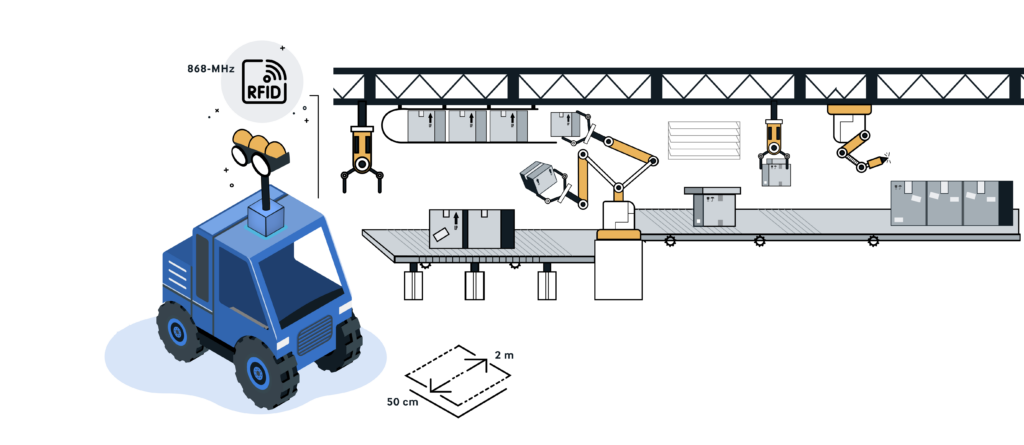
The idea: Instead of powering each measurement point individually, a mobile monitoring vehicle equipped with sensors should travel through the entire facility. In doing so, it should collect all condition data from the sensors attached to the sorting plant’s motors. The vehicle moves at a speed of about 2.5 m/s (approx. 9 km/h) and has a battery life of at least one week. Afterward, the battery can be replaced or recharged.
But how exactly do you pinpoint the recorded measurements? Satellite-based GPS is not an option inside enclosed spaces, and traditional indoor positioning systems using Wi-Fi, Bluetooth, or ultrasound also require costly infrastructure (additional transmitters, cabling, etc.). Another approach—the continuous reading of LiDAR data and its comparison with a digital map of the facility—is precise, but expensive to acquire and maintain, since scanners and computing power must be available at all times.
Location Tracking with RFID: A Promising Option
Given this background, clearly marking each measurement point initially seemed to be the most practical solution. Two technologies stood out in particular:
• Barcode / QR code: Inexpensive and easy to set up, although it would require an energy-intensive barcode scanner with a light mounted on the vehicle.
• RFID (13.56 MHz): Self-adhesive, low-cost tags and relatively economical readers.
RFID in the 13.56 MHz frequency range was particularly appealing: Each measurement point could be uniquely identified by an RFID tag without the need for a line of sight. Nevertheless, some questions remained: Is the read range sufficient at a travel speed of 2.5 m/s? How reliably will the tags be detected if they are within range of the reader for only fractions of a second?
Proof of Concept: Practical Test Setup in the Laboratory
To test whether 13.56 MHz RFID would meet these requirements, our experts first built an Arduino-based prototype: an RFID reader, a few tags—and we were ready to go. However, the initial results showed that stable detection at a speed of 2.5 m/s was not always guaranteed:
• At a maximum range of 5 cm, the tag is within reading range for just 0.04 seconds.
• During testing, IDs were sometimes recognized only every other time. This behavior is due to the way RFID works. Tags are activated by the reader only when they come within range. As soon as a tag is activated, it transmits its ID and enters a READY state, during which it does not retransmit its ID. Only when the tag is moved out of the reader’s range (or when actively interacted with) does it retransmit its ID upon activation.

(Image: RFID for location tracking)
Test Optimization: Rotating Test Setup
A rotating test setup was used to simulate the vehicle passing by under realistic conditions. This allowed the tag to be repeatedly removed from and reinserted into the detection range, thereby circumventing the READY issue. The tests revealed:
• Maximum speed: Under ideal conditions, the system still functioned at 2.9 m/s.
• Improved detection: The rotation caused the tags to be brought into the reading range briefly on multiple occasions, which improved the recognition rate. However, the short range remained a problem.
Why 13.56 MHz Wasn't the Best Choice
The tests revealed two main problems:
1. Reliability: During the simulated pass-by, there was often not enough time to safely activate the tag and reliably read the ID.
2. Range: A reading range of just a few centimeters meant that placing the tags would be too labor-intensive and the margin for error would be too small.
Consequently, it was necessary to consider other RFID options. In follow-up tests, for example, 868-MHz technology was used, which allows for read ranges from 50 cm to 2 m—and the transmission power can also be adjusted flexibly. This not only provides sufficient leeway for fast-moving objects but also accommodates various mounting and environmental conditions.
Temperature Monitoring via RFID—An Additional Option
In addition to position tracking, RFID can also be used for temperature monitoring. There are battery-powered RFID tags designed for this purpose that can independently measure and store temperatures over extended periods of time. While this wasn’t strictly necessary in our project—temperature measurements were taken only as the vehicle passed by to detect a possible rise in temperature (e.g., due to a faulty engine)—this scenario illustrates the potential of RFID:
• Position tracking and sensor data management can be combined without having to install costly wiring or equip each object with its own wireless module.
Conclusion: An iterative approach pays off
This example clearly demonstrates that technical solutions must be effective not only in theory but, above all, in practice. Such an iterative approach—from the initial idea through the proof of concept to the tailored solution—is the key to robust results. The following insights, in particular, have helped us make progress:
• The first attempt is rarely perfect: Even solutions that seem inexpensive and simple can reach their limits in real-world operation.
• Practical tests instead of just theory: Only through testing—under realistic conditions—can we determine whether a technology is robust enough.
• Carefully weigh the costs and benefits: In the IoT environment in particular, it is not only hardware prices that are crucial, but also installation and maintenance costs.
In our projects, we place great emphasis on this iterative approach. This is the only way to select the right technologies and identify potential missteps early on. Ultimately, what matters isn’t having the perfect solution right away, but quickly determining which paths lead to the goal—and which don’t. That is exactly what we mean by expertise: flexible, practical, and cost-effective software and system development.