
Bluetooth Low Energy (BLE) is a wireless communication technology designed specifically for low-power applications. Originally introduced in 2009 as an extension of Bluetooth 4.0 and currently available in version 5.4, BLE has gained significance in many areas since its introduction, particularly in the Internet of Things (IoT). In this article, our experts explore the technical details of BLE, the various profiles, and how BLE is used in the IoT.
Key Specifications of BLE
BLE differs from conventional Bluetooth in a number of technical specifications, making it particularly well-suited for energy-efficient applications:
- Maximum data rate: 2 Mbit/s (theoretical)
- Effective data rate: 0.27 Mbit/s
- Power consumption: Typically in the range of µA to mA
- Frequency band: 2.4 GHz ISM band, operates on 40 channels like Wi-Fi
- Maximum transmission distance: Up to 100 meters under optimal conditions
- Frequency-Hopping Techniques: Adaptive Frequency-Hopping Techniques
- Modulation: GFSK (Gaussian Frequency Shift Keying)
- Transmit power: Up to 10 mW
- Maximum packet size: 31 bytes in versions 4.0/4.1; up to 251 bytes since version 4.2
- Range: 5 to 100 meters, depending on the power level and advertising interval
BLE Profiles
BLE defines various profiles that determine its mode of operation. The most important profiles include:
- Heart Rate Profile (HRP): Real-time heart rate monitoring.
- Blood Pressure Profile (BPP): Measurement and transmission of blood pressure data.
- Glucose Profiles (GP): Monitoring blood sugar levels.
- Proximity Profile (PXP): Using proximity data for key finders.
- Find Me Profile (FMP): Locating lost devices.
Additional profiles can be found in the healthcare sector as well as in the sports and fitness sector (e.g., Cycling Speed, Running Speed, Weight Scale profiles). The Mesh Profile enables communication in mesh networks.
In addition to these specific profiles, two fundamental protocols are crucial for BLE communication: the Generic Access Profile (GAP) and the Generic Attribute Profile (GATT).
Generic Access Profile (GAP)
GAP deals with the processes that occur before the actual data transmission, such as sending and receiving advertising packets, scanning for devices, and initiating and maintaining connections. In doing so, GAP defines four main roles:
- Broadcaster: Sends advertising packets without requiring a connection.
- Observer: Receives advertising packets without requiring a connection.
- Peripheral: Sends advertising packets and accepts connections.
- Central: Initiates and manages connections to peripheral devices.
In addition, GAP also describes the processes for establishing and maintaining connections:
- Advertising: Peripheral devices send advertising packets to signal their presence.
- Scanning: Central devices search for advertising packets.
- Initiating: Central devices establish connections to peripheral devices.
- Connecting: Two devices are maintaining an active BLE connection.
Advertisement & Advertisement Payload
Advertising packets are short messages sent by BLE devices to announce their presence. The advertisement payload can contain up to 31 bytes of data and includes information such as the device name, service UUIDs, and other relevant data.
The structure of an advertising packet includes:
- Preamble: 1 byte for synchronization.
- Access Address: 4 bytes, set to 0x8E89BED6 for advertising channels.
- PDU (Protocol Data Unit): Up to 37 bytes; contains the actual payload.
- CRC (Cyclic Redundancy Check): 3 bytes for error detection.
The main components of the advertisement payload are:
- Local Name
- Manufacturer Data
- Service UUIDs
- Service Data
- Power Level
- Connection Interval Range
- Appearance (e.g., icon)
Generic Attribute Profile (GATT)
Once the connection is established, GATT takes over and handles the structured exchange of data. It defines how data is Services and Characteristics how they are organized and how they are exchanged.
- Service: A container for a group of characteristics, such as a heart rate monitoring service.
- Characteristic: A data value described by attributes such as properties (Read, Write, Notify) and descriptors.
A GATT server (e.g., a sensor) hosts the data, while a GATT client (e.g., a smartphone) retrieves and controls it. Communication takes place via standardized operations such as Read, Write, Notify, and Indicate.
Areas of application:
- Smart Homes: Control of household appliances such as lighting systems and thermostats.
- Wearables: Fitness trackers and health monitors that continuously collect and transmit data.
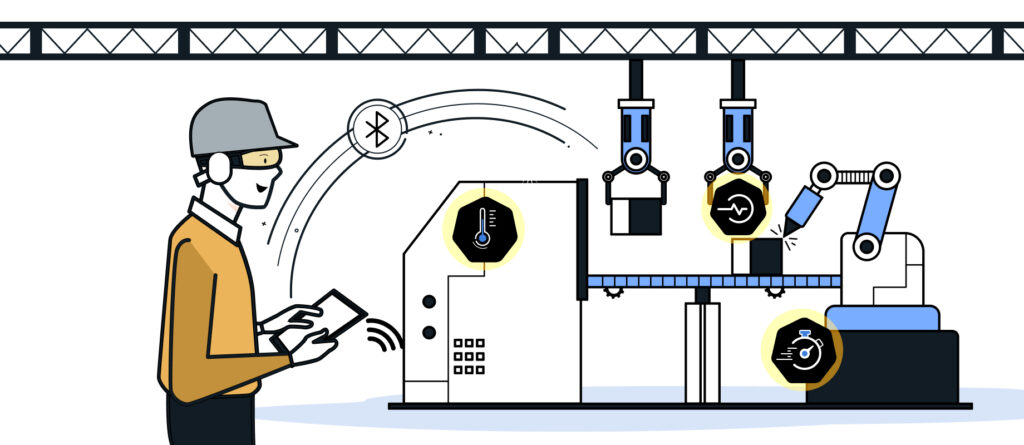
- Industry 4.0: Real-time monitoring and maintenance of machinery to improve efficiency and reduce downtime.
BLE in the IoT
The introduction of affordable, high-performance system-on-chip (SoC) devices with integrated Wi-Fi and Bluetooth has revolutionized the IoT. Thanks to numerous development frameworks and miniaturized sensors, sophisticated applications are now possible in the industrial sector, ranging from environmental monitoring to image analysis.
However, certain technical requirements must be met for the successful deployment of IoT devices in industrial environments. Rugged enclosures and reliable cable connections protect the devices from extreme temperatures, high humidity, and vibrations. Modularity and built-in diagnostic tools also make maintenance and repairs easier.
A critical factor here is the power supply. While modern sensors are highly energy-efficient, data communication can still result in high energy consumption. Depending on the application and specific requirements, batteries, solar cells, or power supplies can be used. BLE’s low power consumption is particularly advantageous in scenarios involving battery-powered devices. Thanks to its efficient use of energy, devices can operate longer without requiring frequent battery replacements.
Furthermore, despite modern Wi-Fi technologies, maintaining stable data transmission remains one of the biggest challenges in IoT environments. This is where BLE can offer decisive advantages. While Wi-Fi supports higher data rates, most IoT applications do not rely on high data rates. BLE offers sufficient bandwidth for most sensor and control applications. Furthermore, BLE uses adaptive frequency-hopping techniques to minimize interference with other wireless technologies. This is particularly useful in environments with many devices and potential sources of interference, as BLE can often ensure more stable communication in such situations.
This technology not only offers an energy-efficient and reliable means of communication, but also provides solutions to many common challenges in such environments. By integrating BLE into IoT systems, companies can increase their efficiency and develop cost-effective solutions.
Conclusion
BLE's various profiles enable a wide range of use cases, from health monitoring to smart homes to industrial automation solutions. By combining GAP and GATT, BLE can meet both simple and complex communication requirements.
BLE really shines in industrial settings where environmental conditions are harsh and requirements are high. It reduces interference, enables stable communication, and contributes to energy efficiency. In addition, BLE offers reliable data transmission and easy integration into existing systems.
While BLE is not the only technology in the IoT space, it offers specific advantages that make it particularly well-suited for certain applications. Companies that integrate BLE into their IoT strategies can benefit from these advantages, such as low power consumption and easy implementation. Nevertheless, the specific requirements and conditions of each application should be carefully evaluated to make the best technology selection.