
Next, we spoke with Danny Hucke. With his expertise, he supports us as the team lead for Digital Product Design and also serves as a research consultant. Last year, he shared his thoughts on AI with us, and we were curious to see if his perspective on the topic had changed.
 Danny Hucke
Exactly one year has passed since our last conversation—how would you assess the progress made since then?
Right now, we're in the midst of the transition from AI assistants to AI agents. As far as use cases are concerned, we're clearly still in the assistant phase. In development, however, the picture is different; work on agents is becoming increasingly common.
What sets these agents apart from their predecessors?
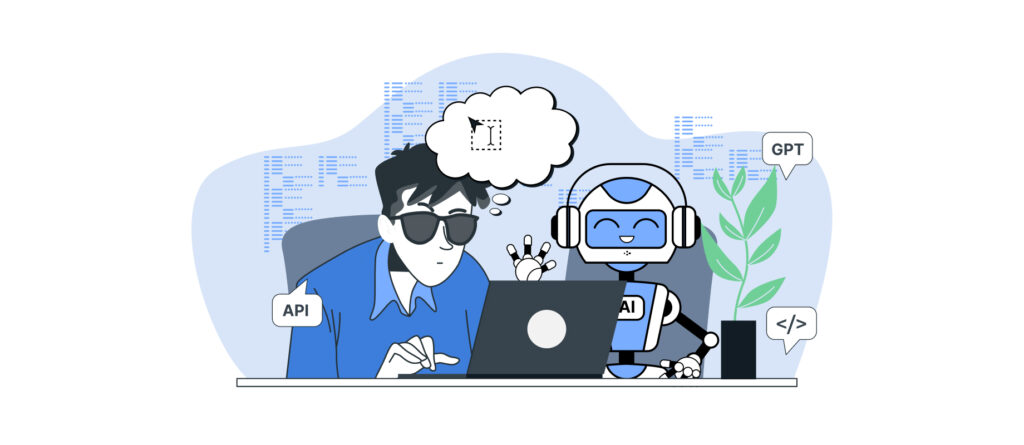
Assistants like ChatGPT operate on a simple principle: input and output. Agents, on the other hand, follow a significantly more complex process. The three key elements are:
Agents do not respond immediately; instead, they are encouraged to think through the query they have been given. They devise a plan and break the task down into subproblems. Essentially, their first step is to rethink the problem. Technically, you can think of it this way: Code is written around the LLM—which is purely an input-output machine—that does nothing other than prompt the LLM to first think about the task at hand, rather than providing an immediate answer. End users, of course, are unaware of this. The problem is first analyzed, and the agents reflect on it.
Put simply, the second difference from assistants is that agents have access to tools. Whether that means a web browser, databases, APIs, or the fact that agents can also execute code, agents are therefore able to search Google—something software developers would do as well. They can determine for themselves whether the code they’ve written actually works.
Last but not least, they identify errors and try to resolve them on their own. This is often referred to as iteration or feedback. This capability allows the tool to continue working indefinitely. It solves a problem and then moves on. However, since every problem could potentially trigger a new one, there is a risk that the agent will get stuck in a loop.
Currently, AI assistants have definitely become widely adopted as support tools. Since the number of agents actually available on the market is relatively small, their use is still fairly limited at the moment. One tool I definitely want to mention here—and which is still relatively new—is Devin AI. Touted as „The World’s First AI Software Engineer,“ Cognition Labs, the company behind Devin, promises an AI agent with capabilities never before seen. Fully autonomous and capable of learning, the tool is able to identify and fix errors, and—in Cognition’s own words—thinks and plans independently. In addition, it is equipped with all relevant development tools—such as a shell, code editor, and browser—and is said to be capable of solving complex software problems.
The fact that GitHub Copilot has over 1 million paying users alone shows that AI-assisted coding has become an integral part of software development.
One issue that is—and will continue to be—a major concern is data protection. Nearly all of these tools send code to the U.S. via APIs, and some also use the data to train their models. This is, of course, problematic in that development artifacts (code, configurations, etc.) are sometimes trade secrets and could potentially become accessible to others through these models. How to handle these tools depends entirely on the policies in place at your own company. GitHub Copilot, for example, promises that the data will not be shared and will not be used to train the models.
With the agents, you've already given us a brief glimpse into the future. What's your take on where we're headed?
Personally, I believe that agents will become increasingly important. Specifically, this means that in the future, developers will solve more and more tasks in collaboration with agents. It will increasingly be the case that developers delegate subtasks to agents, allowing them to focus on more complex problems. Agents are capable of solving tasks autonomously, and developers will increasingly be responsible for testing and reviewing the results.
I also think that the role of software developers will change significantly with the use of these tools. The amount of actual coding will decrease and be taken over by agents. Not only will the number of tasks that software developers delegate to AI agents increase in the future, but so will the ability of these agents to solve increasingly complex problems. Time-consuming coding will become increasingly rare, and developers will instead be busy reviewing and optimizing the code generated by AI agents.
Where do you see future challenges and opportunities?
As these tools continue to evolve, I see challenges for both companies and software developers alike. In fact, for society and government as well. But let's take it one step at a time.
For developers who define their work more or less by actively writing code, things could very well become difficult. However, those who have always been interested in the overall problem and different solutions—or who are used to seeing the big picture, understanding its various components, and delegating them—will very likely benefit from AI tools as well. This is because much more work can now be completed in significantly less time. Overall, I think the role of developers will shift much more toward that of product owners and project managers, and the boundaries between these roles will become increasingly blurred.
Even though the barriers to developing software products are getting lower, that doesn’t necessarily mean fewer developers will be needed. Rather, as a company, I now have the opportunity to carry out projects on a scale that was previously uneconomical. The way I see it, the amount of software isn’t decreasing—it’s actually increasing—so the demand for developers isn’t necessarily going down either. These tools boost productivity and, as a result, expand the possibilities for producing high-quality software. All in all, it has always been the case in IT that as new and more efficient programming languages emerge, the demand for software has also increased. Of course, it will still take a little while for all of this to come to fruition. In the future, it will likely also be possible for companies to build cost-effective, custom software for their own business processes, reducing their dependence on large corporations.
I see challenges above all when it comes to trusting the output of AI. Even the most advanced AI will make mistakes, and here it is especially important to train software developers on how to handle them and to integrate the tools securely into their own workflows. Monitoring will become increasingly important, and anyone who blindly trusts AI could very quickly end up with malware on their system. It’s important to understand how these tools behave and to hold them to the same standards as software developers. What was true back then remains true today: Don’t adopt a solution that you don’t understand yourself. The ability to build software quickly doesn’t, by itself, make it a good product—the quality must also be right. The demands for transparency and adaptability are probably higher than ever before.
We are currently in an era of assistants and agents. While some people aren’t even using assistants yet, there are now those who are actively deploying agents to develop their software products. It’s clear that the role of AI in software development will continue to grow. The emerging agents will give the whole field another boost and cause the growth curve to rise rapidly. The core—or the „brain“—of all these applications is always the LLM. Currently, there are many things being built around these LLMs, and we’ll see a lot more in this area before we reach the limit. It could become truly revolutionary again as LLMs continue to evolve; I can’t predict what will be possible then. However, if development continues along the same lines as it has so far, we’re in for something big.
At the same time, it’s also fair to say that there hasn’t been a real leap forward since GPT-4. Sure, there are models that might be a little better at coding or handling language than GPT-4, but overall, all these models are at a similar level. It’s certainly possible that LLMs have hit a limit for now that we won’t cross anytime soon, even though I don’t believe the models have reached their limits yet. Nevertheless, when it comes to the code and the applications being developed around these LLMs, we’re still in the early stages.
If the brain—that is, these kinds of models—has a limit, then the agents also have a limit, and the leaps we make will become smaller and smaller. But yes, the last few years have, of course, also shown that you can’t get very far with predictions in this area. What I say today may already be outdated tomorrow. In principle, however, when it comes to AI, I don’t consider anything impossible at the moment.
Even though the U.S. remains at the center of this development, there are increasing signs of democratization—albeit only slight ones. Take Mistral from France, for example, and there’s also a lot happening in China right now in this area.
What do you think of predictions that software developers will be replaced by AI in the future?
As things stand now, it’s clear that there are definite limits. These agents aren’t yet capable of doing everything that software developers can do—not even a tool like Devin. They require predefined parameters and depend on high-quality data. For example, these tools have huge problems with legacy code, and I see complex problems of this kind remaining in human hands for quite some time. The job of a software engineer isn’t just about coding itself; there’s a whole lot more to it. First and foremost, you have to figure out what the actual problem is. A big part of that involves translating the customer’s language—that is, what they actually want—into technical language. Currently, a machine cannot reliably determine whether what the customer says actually corresponds to what they want. Figuring out what actually needs to be coded has always been one of the most difficult parts, and I don’t see software developers handing over tasks like requirements gathering, architecture, or client communication to machines anytime soon.
It gets tricky when coding itself is my dream job. Until now, this type of work has been considered difficult and has been well paid accordingly. Suddenly, there are machines that can more or less take over this task—or even people without exceptional coding skills who are programming software with the help of these AI tools. Sure, software development isn’t the first industry to be affected by this kind of development, but when the requirements of a job change, it also has an impact on people. Some will enjoy the new tasks, but for others, the core element of their work is disappearing, and they may find it harder to come to terms with that. Here, it’s important to bring people along for the ride, support them, and not simply cut them loose.
At the same time, we must not forget that research and development are also making steady progress and constantly producing new innovations. New concepts and architectures are constantly emerging and driving the industry forward. Emerging technologies, such as quantum computing, must first be sufficiently understood, and best practices must be established and adopted before they can be effectively utilized by AI tools such as large language models (LLMs). This ongoing innovation presents new opportunities and challenges that are constantly changing and evolving the IT landscape.
Of course, one factor that should not be underestimated in this entire development is the influence of legislation. The EU AI Act, which recently came into effect, has garnered both praise and criticism, depending on one’s perspective. This, of course, has consequences—such as large companies like Google choosing not to offer certain products on the European market in the first place. Overall, this poses a major challenge for everyone involved in the legislative process: to find rules that protect people. Putting people at the center is also a personal priority for me. It’s important to take advantage of the opportunities that AI offers and to develop applications for—not against or in place of—people. Keyword: Human-Centered AI.
At IT Sonix, we are currently working to further expand our expertise in this area and are increasingly striving to empower our employees to work with AI products. It is important to break down barriers. We are also developing our own prototypes and are following developments in this field with great fascination.