
In the world of software development, there is an ongoing debate about how to seamlessly integrate the user experience (UX) into agile methodologies such as Scrum.
UX and Scrum seem like two different worlds that, at first glance, don't seem to fit together because of their distinct characteristics and priorities.
Our new blog post explains how UX and Scrum can work together successfully.
To achieve a realistic representation, we first outline a setup typical of the project:
In a one-year project, the focus is on four developers, a product owner (internal or external), and a Scrum Master. The project follows a structured framework organized into two-week sprints.
Each sprint raises new questions and provides new answers, while the overall picture of the project continues to evolve. Despite this clear structure, the application of UX in this context can be influenced by various factors. We therefore present four different scenarios, each of which highlights distinct challenges and opportunities for the application of UX.
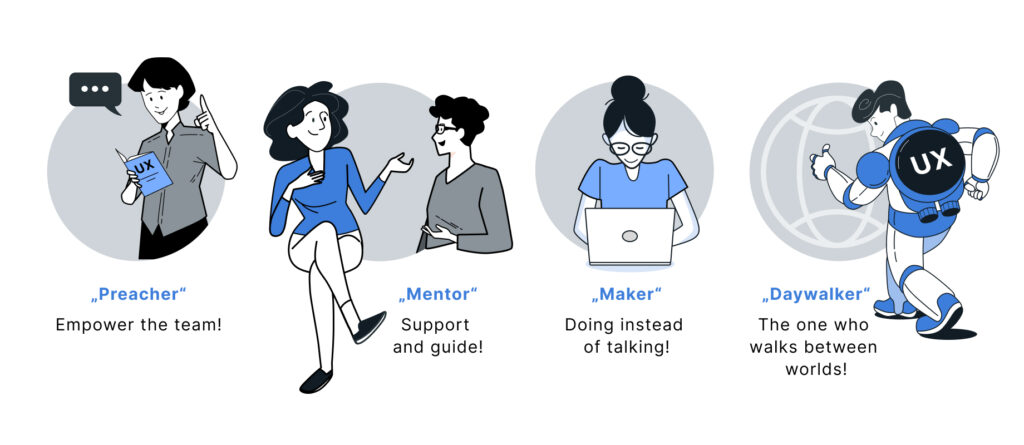
SCENARIO 1: „Preacher“ – Empower the team!

In a project scenario with a very limited budget and minimal user interaction, challenges may arise from unclear expectations and use cases, because, for example, the Product Owner is not prepared to collaborate with the UX team.
When and where should UX be integrated into the development process? And what specific contributions can UX designers make to add value to the project?
Another obstacle is the limited opportunities for coordination between the UX team and the developers, which can lead to misunderstandings.
These uncertainties can lead to delays and the inefficient use of limited resources.
To address these issues, UX professionals can take on the role of „preacher.“.
The „Preacher“ serves as a particularly valuable resource when the team is highly technically focused and has limited experience in UX, but urgently needs an incentive to place greater emphasis on user needs.
He advocates for a user-centered approach and strives to raise awareness within the team about the importance of UX.
This can be achieved by conducting training sessions for product owners and the development team, during which the possibilities and methods of a user-centered approach are demonstrated. The training sessions can utilize various resources, such as standardized questionnaires, interview guidelines, persona templates, and UI libraries, to provide team members with practical tools.
The „Preacher“ can also be responsible for providing concepts, research findings, and designs. However, to ensure that this support works effectively within the sprint cycle, certain ground rules must be established.
The UX Professional, in the role of „Preacher,“ serves as a key point of contact for the entire team and should therefore maintain a strong presence, especially in meetings and appointments. It is important that they create a relaxed atmosphere and avoid taking a lecturing tone.
To give people a good sense of the UX designer’s role on the team, informal meetings are important. During these sessions, the „preacher“ can use good examples from other projects or products to illustrate what has worked well in the past and how UX can add value. This helps foster understanding and acceptance of the importance of UX within the team and strengthens collaboration.
SCENARIO 2: „Mentor“—Support and guidance!

In the next scenario, the budget is tight and there is a heavy workload that must be managed. The challenges are many and varied: There is intense time pressure, as development depends on input from other teams and is moving forward.
The communication workload is high, as effective coordination and prioritization of topics are required. The challenge is to strike a balance between coordination and actual work, while the team also wants to provide input and take an active role.
In addition, there is a risk that too many rounds of feedback will leave insufficient time for the necessary work tasks. Another consideration is the level of detail involved; many UX professionals tend to get bogged down in the details, which can hinder efficiency.
The role of „mentor“ is ideal for addressing these tasks.
It is crucial that the „mentor“ brings a wealth of experience as a UX designer. The „mentor“ must know which tasks require their direct attention and which can be delegated to the Scrum team. Regular and close collaboration with the product owner, combined with clear prioritization of topics and an assessment of necessary research, is essential. It is recommended that the UX designer and product owner schedule a fixed meeting time.
The „mentor“ should actively participate in refinements and reviews in order to clarify open questions early on and address feedback from stakeholders.
Furthermore, the use of assistive devices is important not only for making them available but also for benefiting from them oneself. The reality of such projects requires skillfully balancing available resources and constantly seeking solutions that meet the needs of all those involved.
With the support of their „mentor,“ team members have the opportunity to continuously develop their UX skills.
Accordingly, the role of the „mentor“ could focus in the future on empowering the team to carry out UX work independently, rather than doing it for the team. This requires that the team developing the front end be ready to take on this responsibility. An important aspect of this is understanding and empathizing with the developers’ perspective in order to provide effective support and guidance.
SCENARIO 3: „Maker“—Doing Instead of Talking!

In the third scenario—which, while characterized by a sufficient budget and a lack of dependencies—there are nonetheless a number of challenges that must be addressed.
A large budget goes hand in hand with plenty of time, which in turn means that a wide range of tasks can be accomplished.
One challenge is ensuring the necessary transparency. The urgent need to integrate UX into the sprint cycle adds to this challenge, as results are expected at the end of each sprint. For user testing, it is necessary to schedule fixed time slots in order to find dates with users within the sprints.
Furthermore, due to the lack of connections to other projects, there is also a lack of professional exchange with the UX team, which is a valuable resource for UX designers.
The „Maker“ role takes a hands-on approach to UX tasks and delivers practical solutions. This type of person is particularly effective when quick results are needed and the team requires direct support in implementing UX initiatives.
The „Maker“ within the development team plays a central role in the successful integration of UX tasks into agile projects. A key aspect of this role is fully integrating into the dynamics and working methods of the development team. This includes participating in various team meetings, such as daily stand-ups and sprint refinements, to stay continuously informed about progress and requirements.
Active participation in the development team’s sprint events is also an important aspect. Through this participation, the „maker“ increases their visibility in the sprint and thus becomes part of the sprint rhythm. This enables close collaboration with team members and effective coordination of UX tasks with other development activities.
To ensure that UX tasks are given appropriate consideration and prioritization, it is crucial to make them clearly visible in the backlog and sprint. UX tasks can appear in the backlog either as subtasks within other stories or as standalone stories. Standalone stories serve as the basis for development and require lead time for planning and implementation.
UX professionals and product owners need to work hand in hand and clearly communicate user requirements and dependencies to ensure effective planning for the foreseeable future.
A key role of the „Maker“ is to plan UX topics early on in future sprints and ensure that they are appropriately integrated into sprint planning. It is important not to plan too far in advance, but rather to work in an agile manner and adapt flexibly to new requirements.
It is also recommended to establish a UX review in line with the Definition of Done.
It is helpful to use a user story map and define a clear minimum viable product (MVP). The user story mapping technique enables the Scrum team and the UX team to better understand and broadly outline the required functionalities. This broad outline allows them to gradually refine the details over the course of the sprints, while clearly distinguishing which features are part of the MVP and which are not.
Overall, the role of the „maker“ helps increase acceptance of and understanding for the importance of UX within the development team. Through close collaboration with team members and the transparent integration of UX tasks into the development team’s workflows, it is ensured that UX aspects are appropriately considered and implemented to guarantee an optimal user experience.
SCENARIO 4: „Daywalker“ – The one who walks between worlds!

The challenges in the fourth scenario—which is characterized by a sufficient budget and dependencies on other projects—are multifaceted.
As product complexity increases, the effort required for communication also increases, since various teams are involved in product development and must be included in the planning process. At the same time, decision-making capacity may decline, as strategic decisions must be made that can have an impact on multiple areas. Another key aspect is knowledge transfer, which must occur continuously to ensure that relevant knowledge is always shared and that all team members are up to date.
The „Daywalker,“ who moves between worlds, plays a special role in product development. His job is to build bridges between different teams, technologies, and projects.
His involvement extends to all aspects of the project; he has access to insights that are hidden from other roles and participates in decision-making.
One of the most important roles of the „Daywalker“ is to work closely with software architects to develop a better understanding of the technical aspects of the product and thereby influence future architectural decisions. This involves not only their own area of expertise but also coordinating between backend and frontend teams.
To ensure a consistent user experience, the „Daywalker“ schedules regular UX sync meetings to discuss joint development opportunities.
By sharing research findings and participating in reviews conducted by other teams, he helps create synergies and foster a comprehensive understanding of the product as a whole. In this context, it also makes sense to create and utilize a shared pool of test subjects.
Filters and main navigation tools are common topics where collaboration makes it possible to effectively leverage existing solutions rather than reinventing them.
In addition, „Daywalker“ is working to establish a design system that will serve as the foundation for a consistent product.
To bring all these different areas together, the „Daywalker“ serves as a connecting link and helps ensure that the product offers a clear and consistent user experience even as its complexity increases.
Despite their apparent incompatibility, UX and Scrum offer the potential for fruitful collaboration in software development.
The four roles presented here offer different approaches to integrating UX into a wide variety of project scenarios: from the advisory role of the „Preacher“ to the role of the „Mentor,“ who guides the team and occasionally steps in; the active, fully integrated role of the „Maker,“ all the way to the integrated „Daywalker,“ who is present in many projects but is less often able to take action on their own.
Ultimately, successful integration of UX depends above all on maintaining a strong, active presence within the team and, as a result, highlighting the relevance of user experience design.
The extent to which UX is integrated can be measured using various criteria, such as the number of UX tasks in the backlog and the sprint backlog. In addition, regular check-ins with developers regarding their collaboration with the UX team, as well as gathering feedback during retrospectives, can serve as important indicators. Ultimately, this measurability makes it possible to better understand the degree to which UX is integrated into the team and to make adjustments as needed.
Regardless of the specific challenges and opportunities we face, however, the user should always be the focus. After all, it is the users for whom the product is being developed. Resources such as money and time determine what options are available to us for meeting their needs in the best possible way. It is important to choose the approach that best suits the situation at hand. In doing so, we should be aware that there is no one-size-fits-all solution; rather, we must identify and utilize the right formats.
Agile methods such as Scrum definitely offer a good opportunity to involve all team members in the development process and strengthen collaboration. By placing user-centered principles at the heart of the work and focusing on the needs and expectations of users, we can ensure that the product delivers an optimal user experience.