
Successful products and services need a shared direction. In large software development projects, differing opinions can quickly arise about what a product should look like and what it needs to achieve a specific product goal. To keep everyone on track, our product owners are increasingly relying on the creation of product visions. But what exactly are they, and how are they used effectively in agile software development? That’s exactly what our Xperts are exploring in our latest blog series.
What is a product vision?
A product vision serves as a description of the desired goal for a product. Typically, a product vision includes the product’s various features, functions, and benefits for a specific target audience. It describes not only what the product can do, but also the problem it is intended to solve and the value it provides to the target audience.
These characteristics make the product vision the perfect guide for the entire development team. It generally ensures that all features are aligned with the goal of delivering the desired end product. A product vision also boosts team motivation and enables everyone involved to work toward the same goal without any confusion.
Methods for Developing a Product Vision
Below, we'll discuss the various methods that can help you develop a product vision.
Product Vision Interview
The Product Vision Interview lays the foundation for developing a shared product vision. Three different roles play a crucial part in this process: the recommender, the interested party, and the observer.
The person making the recommendation takes the lead in the discussion. They share their vision for the product and also offer specific recommendations on how that vision can be implemented. Their role is to guide the discussion and keep the conversation moving by asking relevant questions and presenting ideas.
The interested person is actively interested in learning more about the product vision. They ask specific questions to gain a deeper understanding of the vision, thereby helping to shed light on different perspectives. Through their engagement, they ensure that the conversation remains lively and that new insights are gained.
The observer takes on a reserved role and focuses on observing the interaction among the other participants. The observer refrains from actively participating in the conversation so as not to influence the discussion. Instead, the observer gathers valuable observations and can provide constructive feedback afterward.
It is important for all participants to ensure that their responses keep the conversation flowing and foster a positive dynamic. Each role contributes in its own way to developing a comprehensive understanding of the product vision and ensuring that everyone involved is engaged. In this way, the Product Vision Interview can lead to successful outcomes and serve as the foundation for further product development.
Product Vision Statement
Template for a Product Vision Statement:
For the [Target Audience]
which [the following problem] has,
is [our product name]
a [Product Type],
which [these key features] has,
around [the following user benefits]
to generate.
The Product Vision Statement is a key document that clearly defines a project’s direction and goals. When drafting it, it is essential to consider various possibilities and involve people in different roles.
The product vision statement should be discussed in detail to ensure that all relevant aspects are taken into account and that broad consensus is reached. Open discussions make it possible to identify potential challenges early on and find shared solutions.
By involving people with different perspectives and areas of expertise, we can make the Product Vision Statement more precise and comprehensive. It serves as a guide for the next steps and helps clarify the goals and expectations of all stakeholders.
All in all, the product vision statement is an important tool for ensuring that all stakeholders develop a shared understanding of the project and work toward its success.
Example of a product vision statement:
For [tech-savvy users],
which [Organize Your Life Digitally] want to,
is [the X-Phone],
a [Smartphone],
which [High-performance hardware and an intuitive user interface] has,
around [Quick and easy appointment management] to make this possible.
Product Box/Product Book Cover
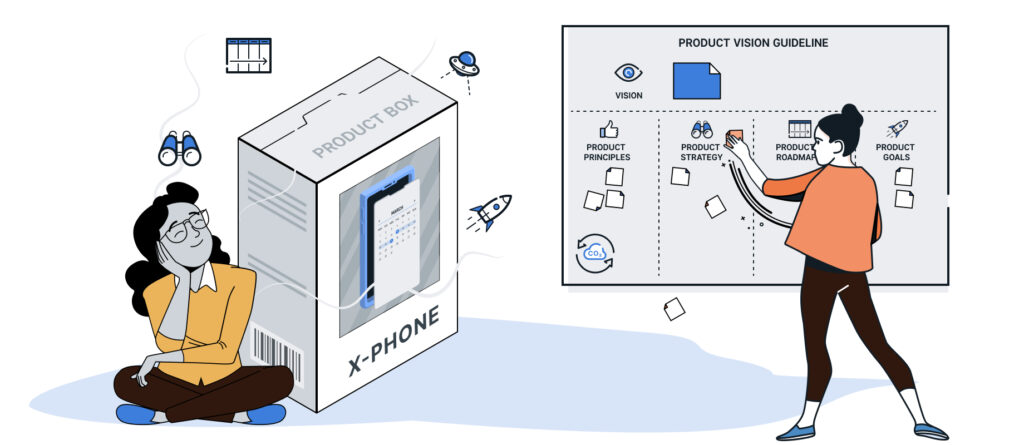
The Product Box is a creative and effective way to highlight a product’s key features and appeal to a target audience. Similar to product packaging or an advertising flyer, it presents the most important aspects of the product in an engaging way to spark interest and encourage a purchase.
The Product Box is designed to feature targeted messaging that highlights the product’s advantages and benefits and is intended to convince potential buyers. It emphasizes the product’s outstanding features and unique selling points to leave a lasting impression.
While the front of the product box displays the most important information, the back contains further details and additional information. For example, technical specifications, requirements, and conditions can be listed here to give the target audience a comprehensive picture of the product.
The Product Box also offers the option of being designed for offline use through brochures and magazines. This enables companies to effectively showcase their products outside the digital realm and reach potential target audiences.
Overall, the Product Box is an effective marketing tool for drawing attention to a product and convincing the target audience of its added value. It combines appealing design with relevant information, creating an attractive way to showcase any product.

Product Vision Board
The Product Vision Board is an extremely useful tool for expanding a Product Vision Statement and adding key information. It serves not only as a supplement but also as a tool for internal communication within the organization and supports strategic decision-making.
When filling out the Product Vision Board, we recommend completing all fields quickly and consistently. This ensures that all relevant aspects are taken into account and allows the board to reach its full potential.
An important step in using the Product Vision Board is to return to the previous field after filling out a new one and check whether the contents harmonize with each other and complement one another. This promotes a coherent and consistent picture of the product vision.
Another advantage of the product vision board is its ability to evolve over time. Through regular updates and adjustments, the board can adapt to changing requirements, ensuring that the product vision remains current and relevant.
Overall, the Product Vision Board offers a structured and effective method for defining, communicating, and continuously refining the product vision. It promotes teamwork, deepens understanding of the vision, and helps define successful product development strategies.

For those who want to go into even more detail, we recommend the Product Vision Board Extended. This expands on the functionality of the traditional Product Vision Board by offering additional fields for an even more comprehensive vision of the product. It enables a more detailed representation of the product vision and integrates research findings as well as other relevant information to ground the vision in solid insights and support strategic decisions.
This enhanced version of the board offers a holistic approach to developing and communicating the product vision, which enables more informed strategic decisions and ensures the product's long-term success.

Strategies for Developing a Product Vision
Developing a product vision requires a strategic approach that ensures all relevant perspectives are taken into account. To develop a comprehensive and meaningful vision, it is important to involve people from various fields of expertise. This includes:
- A person who designs the product, taking into account both technical and design aspects.
- The person responsible for the product, who ensures that business and strategic requirements are taken into account.
- A person who uses the product in order to understand the user's perspective and take the end users' needs into account.
- A person who facilitates the workshop and keeps an eye on the time to ensure that it proceeds efficiently and stays on track.

Ideally, these individuals should come from four different fields of expertise to ensure a well-rounded perspective and to guarantee that all relevant aspects are covered.
A workshop for developing the product vision should be time-limited, ideally to one day. This helps keep the process focused and maintains a high level of participant engagement. It is important to actively involve all participants in the development process to ensure that their perspectives and ideas are taken into account and to foster understanding and engagement.
By strategically incorporating different perspectives and making efficient use of limited time resources, a workshop designed to create a product vision can be an extremely effective tool for developing a clear, meaningful, and comprehensive vision for a product.
The second part of our series will focus on specific methods and recommendations for integrating product visions into agile software development.