
As previously announced, our second WUD recap continues to be full of excitement. From cultural expectations of AI, to soccer-playing robots, a „dancing“ cup, and UX writing, the WUD afternoon once again offered participants a wide range of interesting topics.
Are Cultural Expectations of AI a Challenge for UX Design?
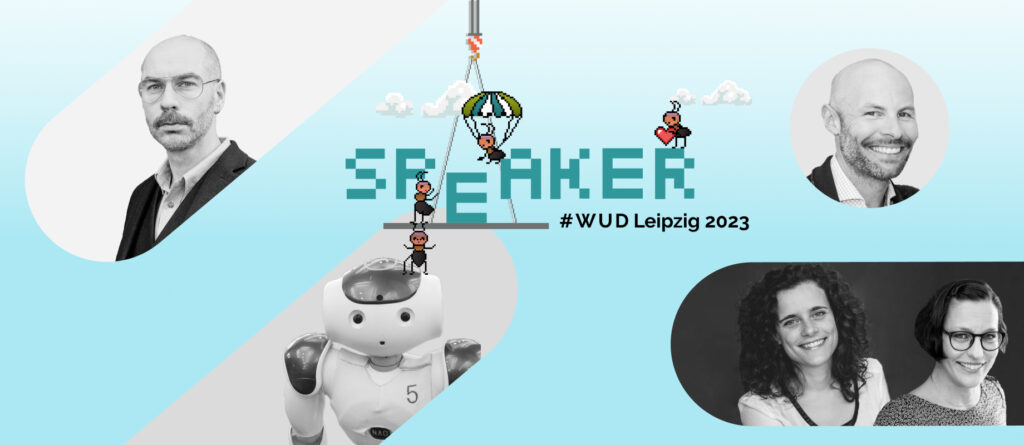
In the first presentation after the lunch break, Holm Hänsel, a senior UX designer at Jambit, explored the question of whether artificial intelligence can meet cultural requirements in global design and development projects.
Especially during the pandemic, the use of AI in collaborative UX design has become increasingly important. According to Holm, AI is increasingly seen as a „sparring partner,“ particularly when it comes to automatically summarizing user tests. This allows UX research processes to move forward more quickly and the quality of ideas to be significantly improved by fully automating the process of filling knowledge gaps regarding content and skills. Nevertheless, a fundamental problem remains: UX teams are, for the most part, not very culturally diverse. Consequently, this diversity issue is also reflected in the data used to train artificial intelligence systems. As a result, the user tests conducted are not truly meaningful, and the products ultimately fail because they do not address the needs of the target audience, Holm further explained.
To address this diversity issue, UX teams should therefore align their prompts more closely with the sociocultural characteristics and regional specifics of the target audience. Given the systems’ potential for error, UX teams are urged to verify whether the generated information is actually accurate. AI can also help make software more sustainable by identifying and reducing energy-intensive features. This is becoming increasingly important, particularly in a global context, where a large number of users generate a high volume of traffic. In this way, UX design can also fulfill its environmental responsibility.
Collaboration & Cooperation on the Field
In the next presentation, Lea Kunz and Felix Loos from the HTWK Robots Team wowed the audience with their little mechanical friends. The robots not only look cute, but also demonstrate their skills as ball-handling artists at the annual RoboCup, a robot soccer tournament.
Off the field, a great deal of preparatory work is required in advance before the robot team is ready to play. This is where Lea and Felix’s team comes into play, as they work to translate all of the robots’ movements into code. Preparing for the RoboCup usually involves a lot of late nights. Still, it’s a lot of fun, Felix said. Cooperation plays a crucial role right from the start. For the HTWK student team, this means constant interaction with other teams at various robotics events, as well as collaborating on exciting and future-oriented research questions. “This allows us to cover the intersection of science, AI, and collaboration exceptionally well,” Lea explained.
In the end, all that hard work pays off: Over the past 7 years, the HTWK team has almost always brought home silver—and once, gold—from the RoboCup. And perhaps by 2050, the team will be able to achieve its goal of defeating a real human team with their robots.
BIBO – the dancing cup
During the final afternoon presentation, Kevin Lefeuvre, a research product designer at the Bauhaus University in Weimar, impressively demonstrated the important role that human-centered development processes can play in the field of care.
As part of the interdisciplinary research project ReThiCare (Rethinking Care Robotics) between the Bauhaus University, Chemnitz University of Technology, and the University of Odense, an interactive drinking cup called BIBO was developed for people with dementia. BIBO reminds them to drink regularly. For example, the cup begins to vibrate if the person has not had a drink for seven minutes. The cup also lights up blue, signaling to caregivers that it needs to be refilled with water, as Kevin explained when describing the prototype’s design. The product concept helps address two specific problems that the researchers identified during field observations at a nursing home. On the one hand, it actively reminds people with dementia to drink. On the other hand, the cup significantly reduces the workload for nursing staff, as it does not need to remain with specific residents for extended periods, allowing staff to care for other residents at the same time. To test BIBO’s effectiveness, an experiment was subsequently conducted at a nursing home in Denmark with people living with dementia. According to Kevin, the results show that residents drank more when using BIBO than when using conventional drinking cups.
In conclusion, the research project encourages us to rethink design and development projects from the perspective of interdisciplinary collaboration in order to meet the needs of specific target groups.
Workshop: UX Writing
While the afternoon presentations were taking place on the main stage at the same time, the second workshop focused on UX writing, a field that is becoming increasingly important today. Using concise practical examples and drawing on their wealth of experience, Katharina Urbantat and Birgit Horn from Invision introduced their participants to what is considered the newest UX discipline.
Just as in UX design, users are at the center here as well, and effective UX writing, in the best-case scenario, guides them seamlessly through the application. The following characteristics play a particularly important role: clarity, conciseness, usefulness, and consistency. If you keep these four things in mind, you’re already well on your way to creating user-friendly microcopy. Good UX writing also benefits from established guidelines, such as voice charts or terminology tables. Armed with these tips, the participants—divided into groups—immediately set to work writing their own texts.
The diverse mix of people from the fields of design, marketing, and technical documentation led to lively discussions and interesting approaches to solutions. Overall, the workshop offered a great opportunity to get a first taste of UX writing and to try it out for oneself.
Summary
This year’s WUD vividly highlighted the importance of „collaboration and cooperation“ in UX design. At the same time, it brought to light new opportunities and challenges that UX design should address going forward. Finally, there’s only one thing left to say: We’re looking forward to next year.