
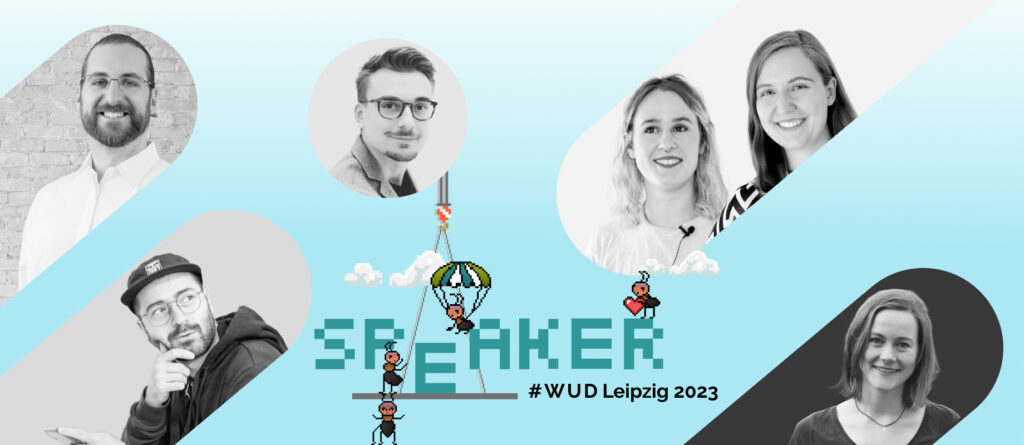
On November 9, we hosted our seventh annual World Usability Day Leipzig. Under this year’s theme, „Collaboration & Cooperation,“ our high-profile speakers addressed topics that matter to them personally and to the UX world in seven keynote presentations and two workshops. We’ve compiled this knowledge and are now presenting it in a concise summary across a two-part series.
The Expert UX Organization
Dominique Winter (Produktwerker) kicked things off with his keynote address, „The UX-Competent Organization.“ He focused primarily on how an organization can succeed in improving its UX expertise and thereby create positive user experiences. To find this out, Dominique spoke with executives who have relevant UX experience and identified five areas of focus: perception, the individual, processes, culture, and resources. These areas of focus are by no means independent of one another but rather form an interdependent system.
However, before improvements can be made, the organization’s current state must first be assessed. To this end, Dominique recommended using the UEQ-S as a measurement tool. This is an abbreviated version of the UEQ+ to assess pragmatic and hedonic quality. If an organization knows where it stands, it can consider ways to improve. The evaluation takes place in three phases: planning, implementation, and utilization. To bring about sustainable change, it is essential to continually question one’s own decisions and results. However, the process is far from over with the utilization phase; it is part of a continuous feedback loop. As a tip for improving organizational UX competence, Dominique not only recommended conducting internal workshops with representative members but also suggested taking a look at how others have done it.
Change takes a lot of time and remains somewhat challenging. According to Dominique, if an organization wants to improve its UX expertise, fostering development at all levels is the most effective way to do so. A UX pilot project is an effective way to convince promoters and sponsors, as its implementation clearly demonstrates the use of UX methods.
UX Strategy: Establishing a Sustainable UX Approach Within the Company—Three Top Tips for Greater User Involvement
For many companies, the mindset is: Everyone is doing UX, so we want to do it too. But how can a company successfully establish a sustainable UX strategy? In their presentation, Christin Hermann and Michelle Greisner (Userlutions) ultimately identified user involvement as the key factor and shared three top tips for increasing it.
Her first tip was all about communication. Since UX and product teams speak different languages, a solid understanding of UX methodologies alone isn’t enough to establish UX within the company. It takes a great deal of social skill to secure the necessary budget and support for change. Members of the UX team must therefore also speak the language of the product teams. To this end, Michelle and Christin recommended conducting user research with the stakeholders. Many aspects—such as needs, limitations, and processes—become apparent through collaboration, and it’s usually sufficient to evaluate and iterate on them.
Christin and Michelle gave us „Showing Up“ as our next tip. To raise awareness of UX within the company, it’s important to participate in various meetings and gatherings (Team Day, Daily, etc.). The key is to bring something to the table to win over the other teams. Concise one-pagers or highlight videos featuring real people are particularly well-suited for this purpose. It’s also a good idea to create a portfolio or a toolkit of methods that speaks to the users’ needs. Above all, it’s important for the other teams to know how much time and budget the project will require.
The last tip they had for us relates to KPIs. To embed UX throughout the entire company in a sustainable way, it’s especially important to understand the company’s overall goals and to view them from a UX perspective. It must be clear to everyone involved that UX contributes to and influences these business goals just as much. In addition, it’s also helpful to track internal UX KPIs (e.g., regular testing of designs, evaluations of tools, or calculating the ROI for a specific feature).
UX and Scrum in Harmony
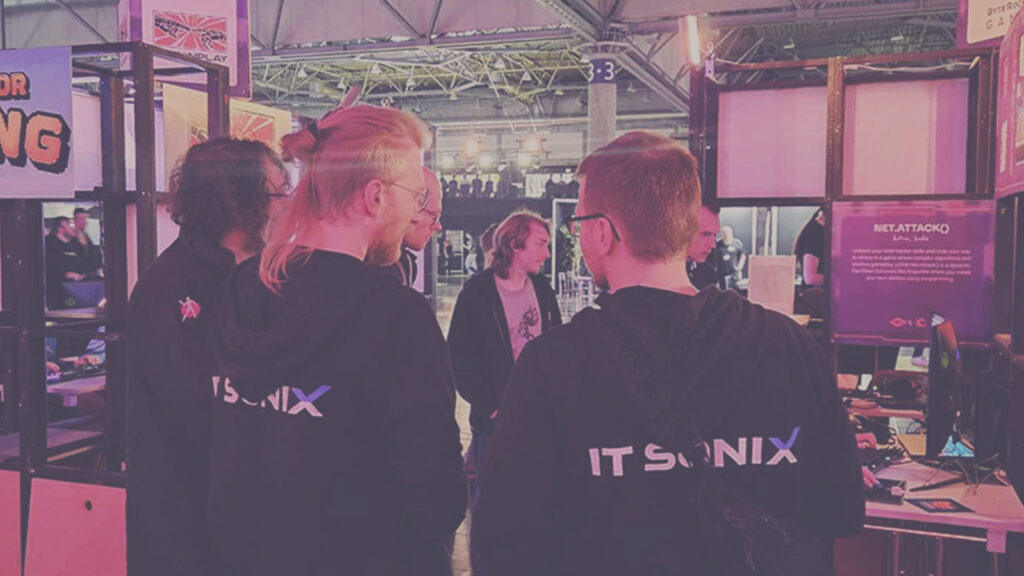
Florian Holzhäuser (IT Sonix) shared insightful perspectives based on his experience regarding the interplay between UX and Scrum. To illustrate his points, he presented four scenarios that present UX designers with various challenges when working with development teams, along with strategies for addressing them.
In the first scenario, there is virtually no budget, and the project involves minimal user interaction. In addition to the limited budget, unclear expectations and potential use cases pose a particular problem here. This can be remedied by having UX designers take on the role of „evangelists.“ In this type of project, the primary focus for UX designers is to foster an awareness of user-centered work—for example, by training the product owner and the team or by providing input on concept, research, and design.
Scenario two is similar, but in addition to the tight budget, it also presents the challenge of a heavy workload. UX designers on such projects are often under time pressure and must devote many hours to communication. The balancing act between coordination and actual work often leads to tension. According to Florian, anyone who finds themselves in such a project must become a „mentor.“ This role often requires experienced UX designers, as well as regular collaboration with the product owner and the use of tools.
The third scenario offers a sufficient budget and, moreover, has no dependencies. Transparency is particularly important here, as is integrating it into the sprint cycle. Collaboration with users must be planned in advance to make use of designated time slots. Due to the lack of dependencies, the connection to the rest of the UXD team can be lost. To succeed as a UX designer in projects of this kind, Florian recommends taking on the role of a „doer.“ You become an integral part of the development team and the sprint events, make UX tasks visible in the development backlog, and establish a UX review in accordance with the Definition of Done (DoD).
In the last scenario, the project has a sufficient budget but is dependent on other projects. Due to increasing product complexity, this project poses the greatest challenge. Dependencies on other products or services increase the communication burden and limit decision-making capacity. Anyone who wants to successfully advance UX priorities here must strive to maintain a presence across the entire company. Florian has coined the term „Daywalker“ for this role. The Daywalker moves effortlessly between the fields of UX and software development. They work closely with software architecture, leverage synergies, and typically implement a design system.
Oops! … I accidentally did some "New Work"
One buzzword in particular is on everyone’s lips right now, not least due to the ongoing digital transformation. We’re talking about “New Work.” In his presentation, Benjamin Rogg (New Work Institute) not only cleared up any confusion regarding the term’s multifaceted definition but also provided a few practical examples of how to integrate “New Work.” In Benjamin’s view, “New Work” is, above all, psychological empowerment. Consequently, all factors that enhance this are New Work measures. These include: competence, meaningfulness, self-determination, and influence. These have a direct impact on job satisfaction, commitment, turnover intentions, and stress. KPIs help identify which measures influence which outcomes.
Not all of the upheavals brought about by digitalization will necessarily have a positive impact on working conditions. To successfully establish "New Work," it is important to examine each situation on a case-by-case basis.
One example Benjamin shared with us to promote New Work in the workplace is the DIN standard: Ergonomic Requirements for Office Work with Display Screen Equipment. This standard includes many proven insights that improve working conditions for individual employees. Even small measures—such as error messages that explain why something isn’t working—can make a big difference. This standard should always be kept in mind during the design process, which is why Benjamin recommends that companies consider holding full-fledged ergonomics sprints or workshops from time to time. Ideally, this can lead to the identification of requirements that are later incorporated into backlog stories or even acceptance criteria.
In closing, Benjamin shared the following thoughts with us. The term “New Work” may change, but the pursuit of a more humane work life based on scientific insights will remain. It is important to ensure that digitalization does not lead to the dehumanization of work. Software design plays a central role here—because good usability not only promotes user-friendliness but also psychological empowerment and, thus, the principles of “New Work.”.
Workshop – A Thousand Tools & No One Even Notices?
Even the first workshop, titled „A Thousand Tools & Nobody Notices?“, drew a large crowd of interested participants that morning. While the digital workplace offers many advantages, it unfortunately also brings with it many sources of stress.
In her opening remarks, Heide Hüttner (ExtraZwei) emphasized that digital stress has become a part of everyday life for many people. In particular, the simultaneous use of multiple digital tools leads to a constant, perceived background noise, which in turn triggers gradual stress reactions. In a work context, the consequences ultimately include constant availability, an overwhelming flood of information, and a multitude of interruptions. As a result, employees are not only significantly less productive but are also increasingly exposed to psychological strain due to reduced recovery time.
We’re all familiar with messenger pop-ups that suddenly appear, an overflowing inbox, or Teams meetings that seem to blend right into one another, according to Heide Hüttner. The participants also reported similar situations at their respective workplaces. Against this backdrop, Heide Hüttner went on to explain, it is important to transition to self-directed media use. She then provided the participants with specific strategies to put into practice.
For example, it can be helpful to prioritize tasks through effective email management, disable messenger notifications during busy periods, and use digital tools more mindfully—and reduce their use if necessary. Communicating fixed times when you’re available to other colleagues, as well as clearly setting break times and rest periods for yourself, can also have a positive effect on reducing stress.
Outlook
Following these interesting and enlightening perspectives, our second part continues with equally exciting content. This section focuses on the afternoon presentations and workshop. In addition to the cultural requirements for AI, we’ll also cover soccer-playing robots, a „dancing“ cup, and the emerging field of UX writing.