
We see ourselves as an attractive employer for talented team players. That’s why it was time to take a closer look at the opportunities and prospects we offer our employees so they can grow and fulfill their potential at IT Sonix over the long term. To that end, we undertook a project lasting several months to address fundamental questions related to human resources and organizational development.
The result is a set of descriptions for all the professional roles we have, as well as—for the first time—a seniority matrix. This provides guidance to all employees, which is of enormous importance to our business success and our corporate culture. But let’s take it one step at a time.
IMPLEMENTATION
To begin with, we designed a standard template for describing all of our functional roles. It was important to us not only to outline the specific tasks but also to explain why a particular role exists in the first place and what specific contribution it makes to the company’s success. Both aspects are intended to provide guidance to current and future role holders on what is expected of them and what they can look forward to in the role. Examples of these roles include Agile Coach, Data Scientist, Usability Engineer, and, of course, the one most of our employees fill: Software Developer.
It was also important to us to clearly outline what is required to successfully fulfill each role. So we sat down together and outlined, for each of these professional roles, the specific expertise required, as well as the personal, social, and methodological skills that are generally needed to perform the role successfully. It is helpful for current and future role holders to know exactly what to expect when they take on the role. This allows them to better focus on their personal and professional development so they can be more effective and successful in their role.
Each job description fits on a single A4 page, making them clear and concise. They will prove helpful to us as a company in many ways going forward—for example, during introductory interviews with new applicants. Based on these descriptions, we’ll be able to better align mutual expectations and goals during these interviews than ever before. We’ll also be able to more easily determine whether a specific role is a good fit for a particular person or whether we should focus more on other roles. These role descriptions will also actively support us in onboarding and employee development. They will make it even easier for us to design onboarding or development plans that are more precisely tailored to the individual needs and preferences of everyone involved.
The roles are assigned to our three major business divisions:
- Software Development & Data Science
- Consulting & Sales
- Central Services (including the traditional support teams: Office Management, Accounting, and Human Resources)
In total, we have over 20 technical roles at IT Sonix. In addition, there are roles that involve greater organizational responsibility, such as team or project management.
As needed, we also assess whether new business requirements present opportunities for introducing additional roles. If so, this also creates additional career development opportunities for our employees. The goal of these activities is not only to meet customer requirements but also to consistently offer diverse and attractive career opportunities at IT Sonix.
SENIORITY LEVELS
That covers the roles and role descriptions. Our next building block builds on this foundation: the seniority levels.
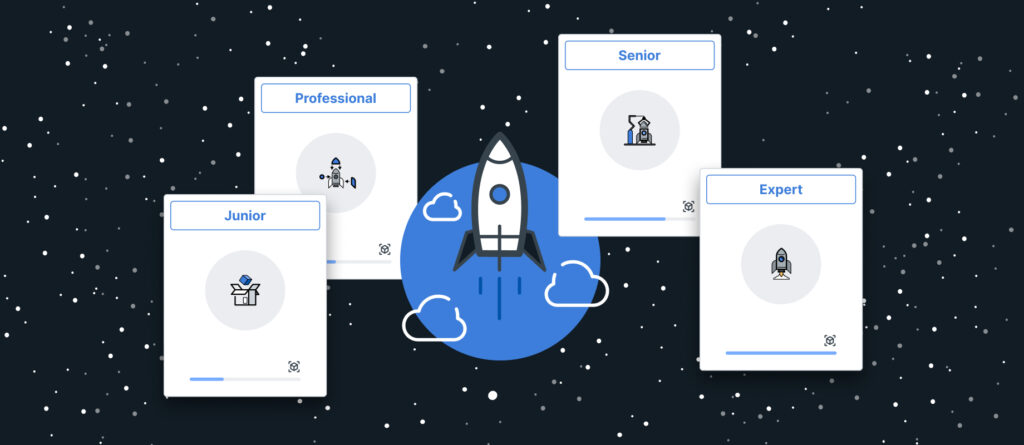
These describe different levels of seniority or experience that employees in specialized roles bring to the table or have already attained. We have a total of four such levels. Starting with Junior, the levels progress through Professional and Senior to Expert. These levels are intended to make it easier for all employees—as well as those with whom they work closely—to provide feedback on where employees currently stand in their development. Of course, factors such as seniority and experience cannot be calculated exactly. However, with the help of the levels we have developed, a fair classification becomes much more transparent and straightforward.
The added value of our tiered model—both for individuals and for the company—is that it allows us to clearly outline what is required to reach a specific tier. This gives our employees a better understanding of how they are perceived and evaluated, and, above all, what they should focus on in their professional development. In the future, we will discuss this topic more thoroughly during regular employee reviews and, based on these discussions, create individual development plans and agree on specific support measures.
INDICATORS
But that’s not all. Long-term professional and personal development requires more than just knowing what a role entails and what levels of experience are involved. And that brings us to the third component of our development and career paths: the indicators. These are used to determine which level employees are currently at and, for example, what the requirements are for our “Expert” level.
This section focuses primarily on the factors that are most important for both IT Sonix’s business success and its corporate culture. First and foremost is the quality of our work. Our customers value the high quality of our products and services. This is also why they have built a trusting business relationship with us over many years. Therefore, it is of central importance to our development and career model that the quality of work performed by employees steadily increases as their experience and seniority grow.
So how is high or very high work quality defined? We base our assessment on both the employees’ own self-assessments and feedback from those who work most closely with them. This ensures that we gather perspectives that are as balanced and diverse as possible when making our determination.
On the other hand, a strong team-oriented approach is just as important to us. After all, we pride ourselves on being an attractive employer for talented team players. In our view, sustainable success is only possible when we work together as a team, which is why this aspect is so important to us. For example, we strive not only to focus on personal growth but also to always keep the well-being of the entire team in mind. Sometimes it can make more sense to set aside one’s own point of view if doing so helps strengthen team cohesion and collaboration. At the same time, this means being open to feedback and incorporating those aspects that can help with one’s own development.
For us, teamwork is also very closely linked to the concept of knowledge sharing. It is important to us that employees with the greatest wealth of knowledge and the most experience pass this on to less experienced colleagues, thereby supporting their professional development. We believe that we can only achieve long-term success as a company by supporting one another and benefiting from each other through the mutual transfer of knowledge.
SENIORITY MATRIX
 These and other indicators are incorporated into our seniority matrix. For each indicator, the matrix defines guidelines and examples of what its level might look like at each respective stage. Again, this isn’t an exact science, but the examples help our employees more easily assess themselves and provide feedback to others. On this basis, we can also better discuss development prospects during our regular employee reviews and design subsequent development plans.
CONCLUSION
So what do all these things actually contribute to? The roles, the levels, the seniority matrix? Here’s a summary of the key points:
- We provide transparency regarding the indicators we consider essential to our long-term business success
- We are making the evaluation of employees' performance and conduct more objective and comparable, and we hope this will encourage employees to accept feedback
- We provide clear guidance on the development and career opportunities available at our company and the criteria we use to determine job classifications.
- We can plan development plans and training programs in a more personalized way and implement them in a more targeted manner
In closing, we’d like to point out that we developed all of these elements—which we consider part of the development and career paths at IT Sonix—together. “Together” means that we sat down with employees from different teams in workshops to develop these elements and provide feedback. This allowed us to incorporate many helpful suggestions, particularly from those who will be working with these tools the most. We’re excited to see how they’ll help us become an even more attractive employer in the future.