
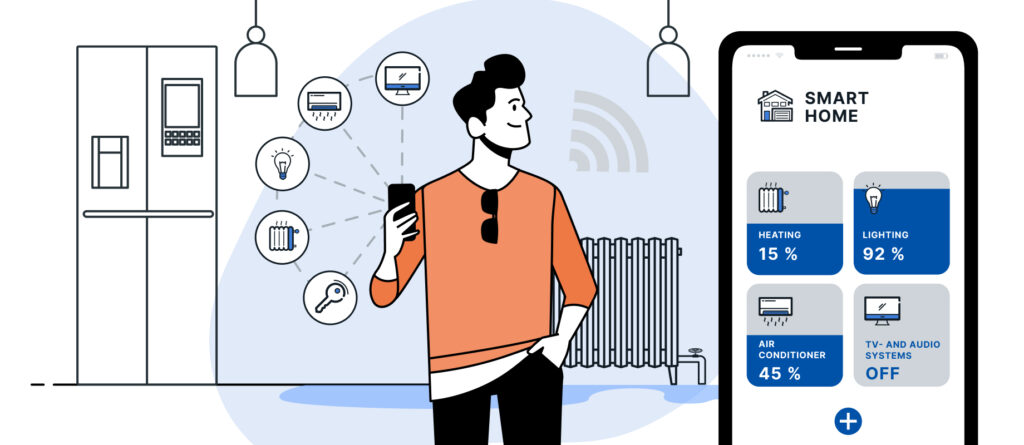
Today we celebrate the birthday of Alan Turing, a pioneer of computer science and artificial intelligence. Turing’s visions and achievements laid the foundation for many things that we take for granted today—and that are still far from reaching the end of their development. Our living spaces, too, are increasingly supported by machines and systems that are becoming more and more automated and interconnected. In our latest blog post, our Xperts explore the possibilities for making your home smart and what you need to consider in terms of security and costs.
By the way, this blog post originated from one of our “impulse” presentations. In this format, our Xperts delve deeply into a specific topic and share their expertise with other employees. Over the years, we’ve built up a considerable pool of knowledge from various fields—not just software development. The format is very popular among our employees and offers a great opportunity to explore areas of interest in greater depth or to present their own ideas to a wider audience. The demand for a keynote presentation on how to make one’s own home smart was so great that we now want to share the knowledge compiled by our Xperts with the wider public.
Whether it’s heating, lighting, ventilation, security, or entertainment electronics—nearly every aspect of daily life within our own four walls can be integrated into a smart-home system. The possibilities are endless, and the so-called “Magic Triangle”—a concept familiar from project management—can be helpful when making decisions or implementing the system.

Those who have limited time but the necessary financial resources will likely opt for a proprietary system that operates more or less on its own and runs smoothly. However, there are also various non-proprietary solutions available in this area that can deliver a high-quality home automation system at a relatively low cost.
For example, the price range for radiator thermostats is approximately 15–50 EUR. Depending on how many thermostats need to be installed, it makes sense to choose one option or the other. However, quality should always be a priority, since an inexpensive but non-functional smart-home system clearly misses its mark: to make life easier for people and simplify their daily routines.
Technologies
Below, we provide a brief overview of what we consider to be the most common technologies and compare them based on price, radio frequency, and the range of compatible devices. It is important to note that the advantages and disadvantages may vary depending on the specific application. In some cases, it is also possible to combine the different technologies.
Wi-Fi is supported by a wide variety of devices and manufacturers and operates in the 2.4-GHz or 5-GHz band. There is a wide selection of smart home devices that are compatible with Wi-Fi and can be easily integrated into an existing Wi-Fi network. The costs involved are generally relatively low. Problems usually arise only when the number of devices increases or when they are located too far apart. As a general rule, transmission speeds tend to decrease progressively once there are 10 or more devices, which can lead to disruptive latency in other devices, such as smartphones.
As far as the selection of manufacturers and devices is concerned, it ranges from Bluetooth roughly in the middle of the pack. Like Wi-Fi, it uses the 2.4-GHz band and offers low costs and low power consumption. Disadvantages include the limited selection of devices and the fact that—even though it is not a proprietary standard—the devices are often tied to specific manufacturers. Despite its ease of pairing, Bluetooth reaches its limits relatively quickly, not least because of its limited range.
ZigBee It’s only slightly more expensive, but offers a very wide range of compatible devices. It’s extremely reliable and, like Wi-Fi and Bluetooth, communicates over both the 2.4-GHz and 868-MHz bands. Its low power consumption and the wide selection of affordable devices make ZigBee the technology of choice for many, even though setup and configuration are more complex compared to Bluetooth or Wi-Fi. Another advantage over the other two technologies is that some of the devices include a repeater.
The proprietary Z-Wave uses the less crowded 868-MHz band. The selection of devices is extensive, though smaller than that of ZigBee. Since every powered device acts as a repeater, it has a significantly greater range than, for example, Wi-Fi. Those who equip their smart home system exclusively with a single technology may opt for Z-Wave despite the higher costs, as the devices offer good interoperability and, consequently, greater reliability.
It becomes even more expensive with Homematic IP, which, like ZigBee and Z-Wave, operates in the 868-MHz band. With this proprietary technology, every powered device also functions as a repeater. The selection of devices is modest—nevertheless, devices compatible with Homematic IP can frequently be found even in the product lines of major supermarket chains. In addition, this technology offers a high level of security.
Next, we'll turn our attention to DECT ULE. Like all the technologies in our selection—except for Wi-Fi and Bluetooth—DECT ULE was also developed specifically for use in smart home systems. The technology is non-proprietary and uses a frequency band ranging from 1.88 to 1.9 GHz. Even though not every powered device here also functions as a repeater, DECT ULE offers a long wireless range and good signal penetration. Device prices are roughly on par with those of Homematic IP, and the selection is also significantly smaller than with other technologies. Nevertheless, its low susceptibility to interference—due to the frequency band used, which does not conflict with other technologies—as well as its low power consumption make DECT ULE an attractive option. Furthermore, this standard is so popular because it is built into many FRITZ!Boxes as standard.
Last but not least, we'll discuss the pros and cons of EnOcean This technology is characterized above all by what is known as “energy harvesting.” Devices derive their energy from their surroundings, such as through movement, light, or temperature changes. At the same time, this feature—along with the proprietary standard—limits the selection of manufacturers and devices compatible with this technology and results in particularly high costs. The low-frequency 868-MHz band is used. From a technical standpoint, EnOcean overlaps most significantly with Z-Wave, meaning it offers good range and high interoperability.
To get the whole thing up and running, you'll need special software—and there's no shortage of options here either.
Software
For the following reasons, we would like to focus primarily on non-proprietary software solutions. Open standards and protocols, in particular, are what make these applications so attractive. They enable the integration of different vendors and technologies without being dependent on a single provider. The systems are more or less easily expandable and have active communities that not only maintain existing documentation but also contribute to the continuous improvement of the software. Last but not least, the solutions listed below stand out for their high degree of customization and the ability to store data locally rather than having to move it to the cloud.
Behind the Acronym FHEM Behind it all lies Friendly Home Automation and Energy Measurement (FHEM). The software is based on Perl and, thanks to its long history, offers a high degree of flexibility in connecting to and integrating other technologies and manufacturers. In addition, FHEM has a sizeable community that is constantly working to further develop the product. Only the user interface and the time required to learn how to use it might pose a hurdle for some users.
At Node-RED It is a flow-based development environment that is also ideal for home automation. Automation workflows can be easily created by connecting nodes. A wide variety of devices and services are supported, and the software also impresses with its user-friendly interface, the Node-RED dashboard. In terms of feature set, however, Node-RED lags slightly behind other vendors, as it does not include a dedicated device management feature, for example.
OpenHAB It was developed in Java and, like the other software solutions in our overview, offers many interfaces for integrating technologies and products from other vendors. The application features a web-based user interface and is very popular within the home automation community.
Also Home Assistant It is very popular among users. The user interface is appealing and can be customized, even to the point of displaying 3-D renderings of individual rooms. It also offers a high level of compatibility with other manufacturers. The large community behind the app is another plus.
ioBroker It is perhaps the least well-known home automation platform on our list and therefore does not have as large a community as the other software solutions. Its advantages lie in its intuitive user interface and the wide range of devices and services it supports. It also offers extensive automation capabilities similar to those of Node-RED.
Domoticz It focuses on ease of use and stands out for its user-friendliness. Its ability to integrate and connect with other devices and manufacturers is also on par with other applications.
All of these non-proprietary software solutions require hardware that must first be set up. There aren't any major requirements; any standard laptop or a Raspberry Pi is sufficient to run a home automation system.
Other home automation solutions that work well but are proprietary and relatively expensive include Homee, Homematic IP as well as HomeKit, Alexa and Google Nest. These applications come with their own hardware on which the software is already installed—so they are much easier to use.
Of course, to make the dream of a smart home a reality, you still need the right smart devices.
Smart Devices
These days, a wide variety of devices can already be integrated into a smart home system. From simple light switches to sophisticated heating and ventilation systems, almost anything is possible. It’s only a matter of time before the use of AI expands even further in this area. While the robot that prepares and serves your meals still seems a long way off for mass use, round robot vacuums are already zipping across more and more hallways in our homes—and the trend is on the rise.
If you enjoy tinkering a bit, are looking for custom solutions, and want to be as independent as possible, you should check out devices with an ESP8266 chip. The chip supports Wi-Fi and has relatively low power consumption. The Tasmota firmware provides a high degree of control and offers significant advantages in terms of transparency compared to manufacturer-specific firmware. Nevertheless, the benefits of proprietary devices should not be overlooked. For example, devices that run on Z-Wave or Homematic IP feature what’s known as interdevice communication. The devices are connected to one another, meaning they communicate directly with each other, and not every action has to go through the control software. For example, if the window sensor is paired with the radiator thermostat, the radiator will turn down when the window is open, without the need to set up complex automation mechanisms. Even if, for example, the Wi-Fi goes down or the hub is offline, the devices continue to function.
Conclusion
Our brief overview shows that there are already several ways to automate your home today—without immediately facing financial ruin or outsourcing your data to cloud providers. Nevertheless, it’s safe to assume that the market will be dominated even more by the major providers in the future. Currently, however, other systems and technologies that take a non-proprietary approach are also being developed.
Matter and Thread are particularly worth mentioning in this context. Matter aims to simplify the integration of smart devices and improve their interoperability, while Thread is a wireless communication protocol for the IoT that enables reliable and secure communication between smart devices. In the future, a large number of ZigBee devices are expected to be retrofitted with Thread via a firmware update. The organizations developing Matter and Thread are backed by major tech companies such as Google and Apple.
The trend in this area, too, is toward ever-increasing automation and connectivity. Artificial intelligence will play an increasingly important role in this context—and even if the smart home control systems of the future may not be quite like Arthur C. Clarke’s HAL 9000 from 2001: A Space Odyssey Whatever form it takes, it is nevertheless more than likely that these home automation systems will be controlled by AI in the future. Given the current pace of development, the moment when the first AI passes the Turing Test seems closer than ever.
One thing is certain: anyone deciding to set up a smart home should do their research beforehand to figure out exactly what they need from a home automation system. For those who want things to be as simple and convenient as possible, it’s worth taking a look at the smart home solutions offered by the major providers. On the other hand, if you prioritize maximum independence and local data storage—and enjoy tinkering a bit—you should take a closer look at the non-proprietary technologies and software solutions featured in our overview.