
Conflicts arise wherever people work together—including in software development. Differing opinions, conflicting interests, and tight deadlines make friction within the team inevitable. But what exactly is a conflict? Why do we often react to it so emotionally? And what strategies are there for resolving conflicts constructively?
Our team of Scrum Masters and Agile Coaches has thoroughly explored these questions and participated in a training program on conflict resolution. Because we believe in sharing knowledge throughout the company, we’ve shared our key insights internally—and now we’d like to share them with the outside world as well.
What is a conflict?
By definition, a conflict is a difficult situation that arises from the clash of opposing views or interests. For a conflict to exist at all, two conditions must be met:
- Two elements (e.g., motives, needs, interests) are in conflict with one another or are incompatible.
- There is pressure to take a stand or make a decision. Conflicts are neither good nor bad—they are a natural part of human interaction and, therefore, also part of everyday work life in development teams.
How do we respond to conflicts?
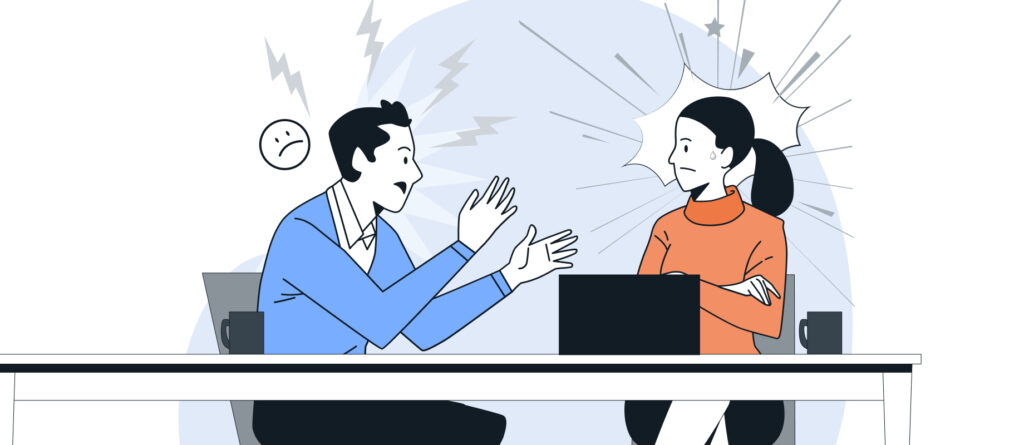
Conflicts trigger a stress response in us. A simple example from a software development team illustrates this clearly:  Toni (software development) receives critical feedback from Sascha (product owner). Toni's body immediately reacts with a series of typical stress symptoms:
- Physical: Adrenaline rush, increased heart rate, shallow breathing, sweating.
- Cognitive: Perception narrows to focus on the „threat,“ confirmation bias sets in („Sascha just wants to hurt me“), and the ability to empathize declines.
- Behavioral Patterns: Fight-or-flight response – Toni is either inclined to defend himself or to withdraw from the situation.
These reactions are deeply ingrained in us. In conflicts, we often fall back on simple patterns of thinking and communication, as described by the psychologist Virginia Satir.
Patterns of Thought and Communication According to Satir
Virginia Satir distinguishes four response patterns in conflict situations:
- The accusatory guy: Looks for faults in others, becomes loud and tyrannical, and never shows weakness.
- The Calming Type: Puts their own needs aside and tries to please others at all costs.
- The Distracting Guy: Responds evasively, changes the subject to avoid confrontation.
- The Rationalizer: Remain unemotional, analyze objectively, and show no emotion.
Every person has elements of all types within them—but in stressful situations, one dominant pattern usually prevails. This can limit one’s scope for action, which is why it’s helpful to become aware of these patterns.
Conflict Resolution Strategies According to Karl Berkel
So how does Toni deal with the conflict? Depending on whether the focus is on his own interests or those of the other person, different strategies emerge:
- Give in: Toni acknowledges the criticism and promises to improve in the next sprint, but is not acting in his own best interests.
- Enforce: Toni stands by her point of view and, in extreme cases, even threatens to take action (such as leaving the team).
- Prevention: The conflict is ignored, but this often only makes it worse.
- Compromise: Both sides are moving toward each other, but they must also make concessions.
- Collaborative Problem Solving: The parties to the conflict are working together constructively to find a solution that takes both sides' interests into account.
Depending on cultural influences, certain strategies are viewed differently („The wiser person yields“ vs. „Conflicts must be resolved“). No strategy is inherently better or worse—it always depends on the specific situation.
What are the functions of conflicts?
At first glance, conflicts often seem disruptive, but they serve important functions—especially in agile development teams. Klaus Eidenschink describes the various roles that conflicts can play. These are particularly relevant in software development:
1. Conflicts require us to choose between alternatives:
Development teams are regularly faced with technical or strategic decisions in which different interests clash.
- Example: A Scrum team is discussing the refinement with the stakeholders. While the development team wants to prioritize technical improvements to enhance maintainability and security, the stakeholders are focusing on new features for the customer. The conflict forces the team to make a clear decision and weigh which option offers the greatest long-term value.
2. Conflicts prevent stagnation and drive innovation:
When everything runs smoothly, there is little incentive to change. Conflicts disrupt existing routines and can thus spark new ideas and innovations.
- Example: A new team member brings fresh perspectives and different ways of working. At first, the established team members see this as a challenge, since their existing methods are being questioned. But it is precisely these discussions that lead to a reevaluation of tried-and-true processes and, potentially, their improvement.
3. Conflicts increase a team's resilience and help stabilize it:
In agile teams, structures and processes must continuously adapt to new requirements. Conflicts can help uncover blind spots and gaps in processes and make teams more resilient in the face of future challenges.
- Example: A development team realizes that there is a lack of clarity in the process at a critical point—for example, who is responsible for a particular code review. The conflict over these responsibilities prompts the team members to develop a clear set of guidelines that will ensure more efficient workflows in the long run.
4. Conflicts help us deal with uncertainty and expectations:
Software development is complex, and expectations regarding quality, speed, and collaboration are not always clear-cut. Conflicts often arise when these expectations do not align—but they allow us to recognize and address these ambiguities.
- Example: A Scrum team is in the "storming" phase, during which team members are just getting to know one another. Differing views on code quality, punctuality, or communication channels lead to friction. These conflicts force the team to discuss common standards and establish a foundation for successful collaboration.
Conclusion: Conflict as a Driver for Better Collaboration in Software Development
Conflicts are a part of everyday work—especially in software development, where different perspectives come into play. Whether it’s technical decisions, backlog priorities, or team dynamics, points of friction are inevitable. What matters is how these tensions are addressed—because conflicts that are handled well create new perspectives, enable sustainable decisions, and lead to more effective collaboration in the long run.
A conscious approach to conflict creates room for maneuver. Those who understand the psychological mechanisms at play and the available strategies for resolution can respond with greater confidence and foster productive discussions. This leads to new perspectives and sustainable decisions rather than deadlocks.