
Companies pursue different strategies to retain their customers. The most important thing is to understand customers’ needs. Whether B2B or B2C—all customers have needs. How can these needs be identified, and how can they be used to develop an effective strategy for long-term customer loyalty? The answer is: journey mapping. But what exactly is journey mapping?
What are journey maps?
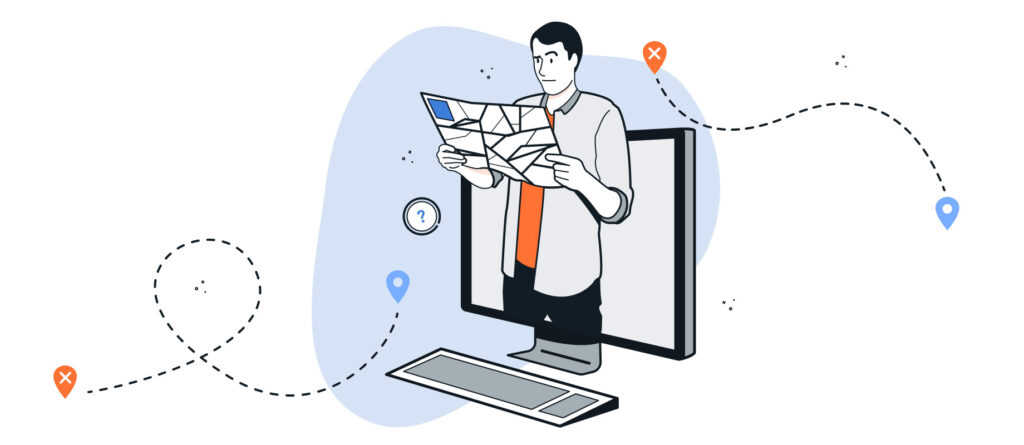
Literally translated, the English term „journey map“ simply means „travel map.“ Journey maps are valuable tools for visually representing the „journeys“ of specific target groups. From a business perspective, they provide a holistic view of a target group’s interaction with a product or service.
Key to this are the so-called touchpoints: the points of contact between the company and its target audience. Each touchpoint holds great potential to have a lasting impact on the customer relationship. Journey maps help identify these touchpoints and provide an overview of the entire customer or user experience. This process adopts the perspective of the target audience—defined as a “persona” in journey mapping. Positive and negative experiences are identified and can thus be effectively enhanced or resolved. The goal is to improve the customer experience (CX) or user experience (UX) and thereby build long-term customer loyalty to the company.
Types of Journey Maps
Generally speaking, there are two types of journey maps: customer journeys and user journeys. Customer journeys focus on the entire customer journey and begin at the very first point of contact with the company. User journeys map the paths of users and their interactions with an application, beginning with their first contact with it. Both follow the same basic structure.
Typical Structure
The horizontal axis shows the phases that the persona goes through in chronological order. The vertical axis includes categories such as goals, actions, touchpoints, and emotions to enable a detailed analysis of each phase.

Create a Journey Map
There is no single method for creating your own journey map. The process, as well as the persona, phases, and categories, depend on the specific company, its customers, and the desired outcome. Guidance on this topic can be found in professional literature and online. Generally speaking, there are three distinct approaches to creating a journey map:
- Workshops with subject matter experts on customer needs
- Statistical Surveys (Quantitative)
- Interviews with the target group (qualitative)
Our Best Practices
Here at IT Sonix, we have found that, for our purposes, the method based on target group interviews works best. Below, we would like to provide a brief overview of our best practices for creating a journey map using the interview method. This process can generally be divided into three consecutive steps:
- Develop a Structure
- Conduct interviews
- Summary of the Results

Develop a Structure
The first step is to review all documents and, if necessary, conduct interviews with stakeholders. Next, the persona, as well as the phases and categories, are defined. Based on this, an interview guide is created, and the target audience is then invited to participate in the survey based on the persona.
Conduct interviews
In the second step, the interviews are finally conducted. Depending on the population and a reasonable level of effort, ten to twenty interviews, each lasting approximately one hour, are recommended. The selection of participants should be representative and random. Together, the group fills out a timeline, and observers document the interviews in writing. This step highlights the key advantages of the interview method. Not only does it provide insights into how customers actually think, but it also makes it possible to deliver reliable results even with a small number of participants. Furthermore, interviews offer the opportunity to engage in dialogue with respondents, thereby contributing to a deeper understanding of the persona.
Summarize results
In the final step, it is necessary to synthesize the results. This involves reviewing the phases and categories of the map and analyzing the interview results. Finally, the content is finalized, and the map is presented graphically.
Journey mapping helps us understand customer needs in a way we've never been able to before—and has a positive impact on increasing revenue and customer loyalty.