

It’s been just under a year since we surveyed our Xperts for AI Appreciation Day. Since then, there have been quite a few developments in the industry when it comes to AI. New AI tools are being released almost every month, and in March, Devon AI even became the first AI software engineer to hit the market.
We once again asked our Xperts for their take on the current situation. As members of our AI task force, they share some insider insights and even venture a prediction. Kicking off our series is Artur Schiefer, who is not only the head of software development and data science but also a member of our executive board.
 Artur Schiefer
How do you assess the current situation?
Right now, we’re still in the midst of the hype phase. There are many companies that are very interested in working with AI but don’t yet have the necessary experience or are just taking their first steps with it. Many are also still at the stage of getting their data ready for training, and that’s not as easy as it sounds. The key here is to figure out exactly what it means to provide a suitable data pool for AI systems. Ultimately, this is also a very costly endeavor that requires a great deal of effort (consulting, time, energy, etc.).
Currently, AI is primarily funded by investors rather than customers. It is not yet clear what the actual cost of deploying AI on an industrial scale will be. I’m not referring to software for end users on, say, smartphones or tablets—that will become possible quickly and, in some cases, already is. Anyone looking for high-performance models for industrial applications will certainly pay prices in the future similar to what we pay today for cloud computing.
If we look specifically at our industry—software development—it’s clear that AI tools are becoming increasingly powerful. In the future, AI tools will take over many standard tasks—from requirements engineering through actual development to test acceptance—and will accelerate and improve these processes. In the medium term, however, I do not see AI being able to perform these tasks autonomously. Unless the tasks are relatively simple, we will still need people to at least ensure the quality of the AI results. I also think that product ideas, in particular, will remain in human hands. Humans are not rational, and it is difficult to predict what will resonate with them. Human intuition cannot be imitated by a machine.
As far as Germany is concerned, there are currently just 2–3 relevant AI systems (Aleph Alfa, DeepL) that were developed here. At the same time, there is also a thriving startup scene that is currently adopting and utilizing AI. For a few years now, a shift in thinking has also been noticeable at universities. Data science plays a much larger role than it used to. For many students who come to us today, data science methods are an integral part of their way of working. This is due, among other things, to the fact that data is still regarded as the new gold. This is also evident in the rapid rise of Python as the language of data scientists. The volume of accumulated data is growing exponentially, and new methods—such as machine learning—are needed to work with it and generate new insights. At the same time, the role of AI in the field of data science has also increased significantly.
I’m reluctant to label traditional data science methods and statistics as AI, even though it’s certainly not easy to draw a clear line here. In my view, traditional data science methods will continue to be relevant in the future. There are also several examples where attempts to develop AI have led to much simpler solutions to problems, simply because they provided a fresh perspective on data and processes.
You've already given us a little glimpse into the future—could you be a little more specific?
I think what we're going through right now is comparable to the phase when the Internet was first being commercialized. If someone had asked in the early 1990s what changes this would bring to our daily lives, 99 % would have been wrong—and I think the same is true of AI today.
When it comes to software development, a lot will revolve around how to use these new tools. As new tools enter the market, the professionals working with them will need new skills and a great deal of experience. For example, to determine which tasks are ultimately worth using AI for—or where AI-generated solutions still need to be refined. Another key point is that generative AI, in particular, has so far only provided a glimpse into the past. Software development will not stand still and will be continuously driven forward by experts. Generative AI will then need to be retrained. Anyone who wants to remain competitive now needs excellent software development that can integrate AI tools into their daily work in a way that adds value.
What do these developments mean for IT companies in Germany?
When I look at our company or software companies in Germany in general, these upheavals naturally lead to a number of conclusions.
We are currently in the process of preparing our employees to use AI in software development. It is important to provide employees with the appropriate tools and to train them in their commercial application.
We have currently established something of an AI task force within our company. I am also part of this group, and together we determine which AI tools are best suited for our work and our customers, and how we can efficiently integrate them into our processes. We’re not only empowering our employees to use these tools, but also creating the regulatory framework for their safe commercial use. In doing so, we strive to stay as close as possible to our employees while also keeping our clients’ interests in mind. Shared interests are always the best motivator for creating something new.
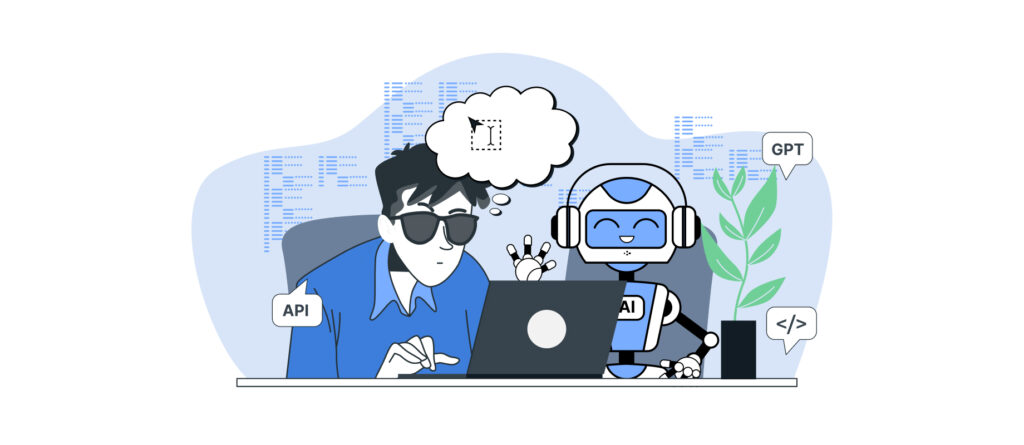
Even though making precise predictions is difficult, AI naturally offers great opportunities for software development. It will be possible to produce professional code much faster. High-quality solutions based on proven patterns and architectures will emerge at a previously unimagined pace. AI knows what has already been successfully solved and can support software developers with its knowledge. In particular, tasks that many developers consider rather tedious—such as writing documentation, creating API descriptions, debugging, or even merging code—will largely be automated by AI tools in the future.
So far, only so-called “weak AI” exists. It lacks human cognitive abilities. When it comes to unsolved or new problems, humans will continue to play a major role. Nevertheless, it is, of course, exciting to link artificial intelligence systems from different domains so that these domains can then collaborate automatically and arrive at a solution.
Where do you see problems related to AI?
Like everything else, the use of AI has its downsides, and it all depends on how it is used. We’re already seeing AI-generated clickbait, spam, and phishing emails. Overall, there is a great need to raise awareness in society, from the youngest to the oldest. Just as there are instances of unfair AI use, tools are constantly being developed to counter them.
Simple tasks that used to be performed by people will be taken over by AI tools in the future. If we look back at the history of digitalization, we can see that many tasks once performed by people—for example, in the office sector—no longer exist in their original form today. This trend will be further accelerated by the synergies between digitalization and AI and will spread to all industries, right down to their sub-sectors. It remains to be seen just how significant the impact will actually be for the affected groups in society.
At the same time, the use of AI naturally offers advantages as well. People are freed from routine tasks and gain entirely new perspectives. In the context of software development, AI helps, first and foremost, to alleviate the acute shortage of skilled workers. The role of software developers will change, just as it has in the past. For now, only humans can solve new real-world challenges in a digital environment.