Today, software products are held to strict standards: They are expected to be efficient, intuitive, visually appealing, and secure all at once. To meet these expectations, it is not enough simply to provide functionality. What matters most is how these features are designed and brought to life.
At IT Sonix, we involve our usability engineers and user interface designers in the software development process from the very beginning. They support the development process using proven methods, established procedures, and ongoing dialogue with users.
This early integration of UX not only ensures user-friendly solutions but also significantly reduces development costs and the need for revisions. The result is applications that are technically sound and economically viable.
An Overview of Our Process
The User-Centered Design Process at IT Sonix follows a cyclical process. The requirements gathering, concept development, and design phases alternate, supplemented by continuous testing and evaluation. In this way, products are developed step by step and in close coordination with the development team, stakeholders, and users.
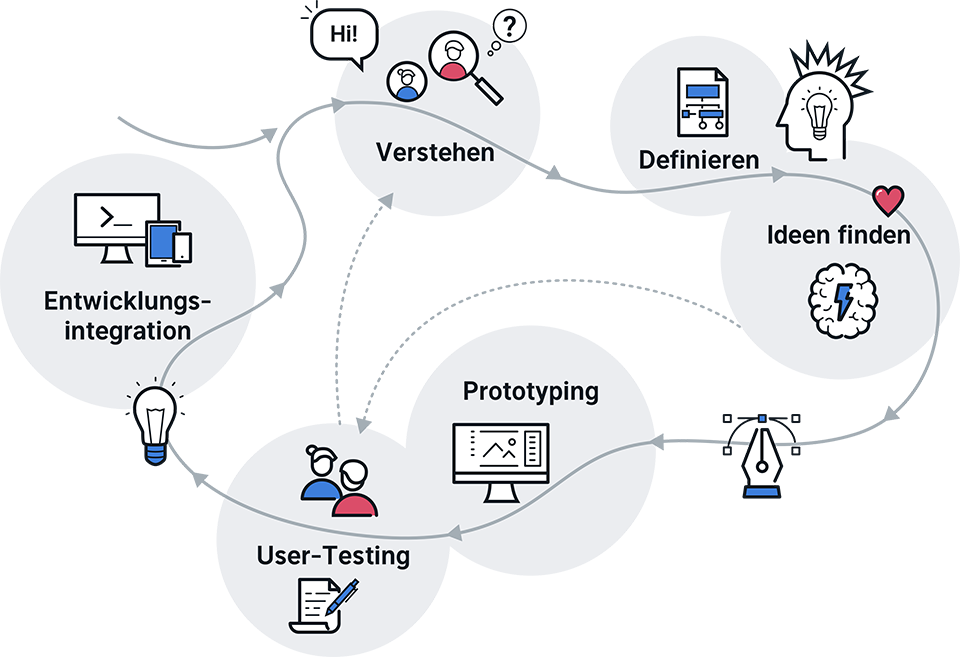
Phase 1: Understanding
The first step is to understand the context of use.
-
- Who will use the product?
-
- How and how often is it used?
-
- What are the users' goals?
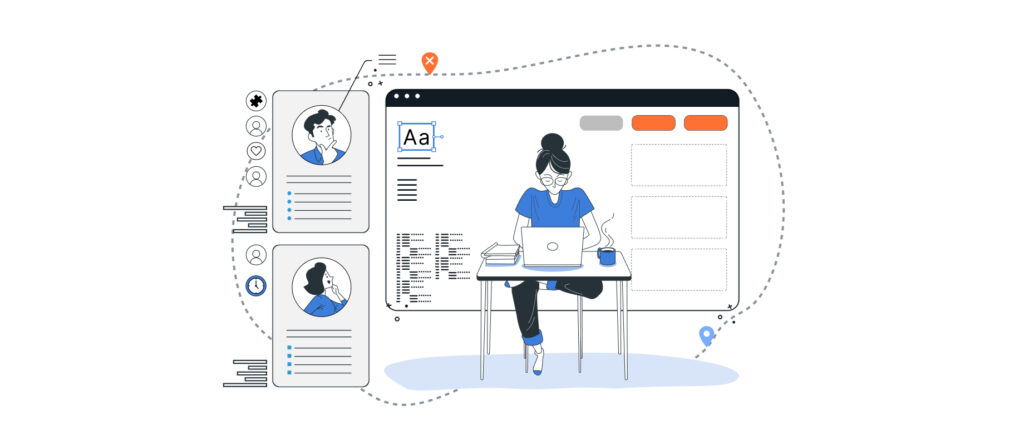
To answer these questions, we rely on methods such as contextual interviews and personas. Personas are fictional user profiles that help us better understand the real people behind the project. They make the abstract „user“ tangible by depicting specific characteristics, needs, and scenarios. On this basis, clear usage scenarios can be developed.
Phase 2: Defining & Generating Ideas
The findings from the analysis are translated into specific requirements.
We develop use cases, workflows, and an information architecture. At the same time, we generate initial ideas for interaction design. Proven methods such as user story mapping and Jobs to be Done help us define the scope of an application and align user expectations with our clients’ requirements. The goal of this phase is to establish a shared understanding of what needs to be implemented.
Phase 3: Prototyping
Now we bring concepts to life. Using wireframes or high-fidelity prototypes, we test whether our ideas work.
These intermediate steps answer important questions:
-
- Have all requirements been taken into account?
-
- Where are there still gaps?
-
- How does the solution work in practice?
Prototyping is therefore a key component in gaining clarity about feasibility at an early stage.
Phase 4: Evaluations
Regular testing is at the heart of our user-centered approach. Through usability tests and expert reviews, we ensure that requirements are correctly interpreted and implemented from the very beginning. Feedback from real users allows us to identify weaknesses, remove barriers, and test hypotheses.
Phase 5: Development Integration
We incorporate validated designs directly into the development process. Our UX experts are an integral part of the development team and participate in regular coordination meetings such as daily stand-ups, refinement sessions, planning meetings, and retrospectives. This integration ensures that concepts aren’t developed in isolation but are implemented hand in hand with product owners and developers. The iterative approach also allows us to respond flexibly to new insights or changing conditions.
Workshops as a Catalyst
In addition to the phases described above, we make targeted use of workshops to efficiently address complex issues:
-
- Lightning Decision Jam: Structured problem identification and decision-making within an hour.
-
- Jobs to Be Done: Identifying relevant features that address real user problems.
-
- Design Sprint: An intensive four-day collaboration with all relevant stakeholders to develop consolidated ideas and implementation outlines.
-
- User Story Mapping: A shared understanding of the appropriate scope of an application.
These formats help bring together different perspectives and quickly arrive at viable solutions.
The UX Circle at IT Sonix
For us, user-centered design doesn’t end with day-to-day project work. With the UX Circle, we’ve created an internal forum focused on advancing our UX/UI expertise. This is where experts from different areas of the company come together. Together, we pool our know-how on designing digital products, reflect on current trends, and help shape the way we’ll work in the future.
Topics we focus on:
-
- Focus on Accessibility: From the user interface to UX writing, we analyze how accessibility improves the user experience. Based on these findings, we develop a set of guidelines for future projects. This provides clarity and ensures that our software solutions are inclusive.
-
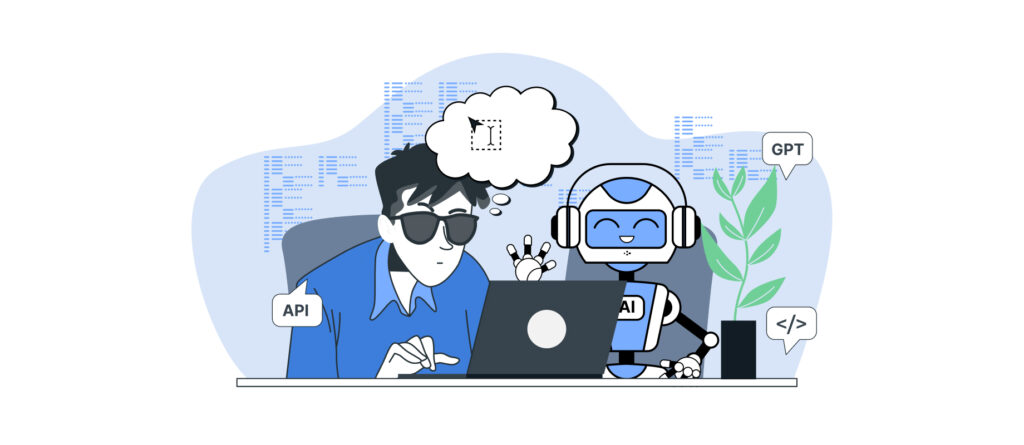
- AI as a Game-Changer: We are experimenting with AI-powered methods—whether for automated usability analyses, rapid prototyping, or smart support in research. The goal is to make our processes more efficient and our results more innovative.
-
- Knowledge Building & Exchange: Through internal workshops and presentations on research methods, commonly used tools, and the application of AI, we strengthen our expertise while also increasing our appeal to external audiences.
-
- Technical Implementation – Hand in Hand: The Circle networks with other Circles, for example on topics such as rapid prototyping and the implementation of accessibility. This creates synergies that extend beyond the field of UX.
The UX Circle is therefore more than just a working group. It is a driving force for innovation, knowledge transfer, and quality assurance within IT Sonix.
Our Team
The success of the process depends heavily on the teamwork of our team.
Our usability engineers and user interface designers bring many years of experience in the design and optimization of complex software applications. They combine methodological expertise—from requirements gathering and design systems to evaluations—with close collaboration with the development team. This ensures that ideas don’t just work on paper, but take shape as market-ready products.
Benefits for Our Customers
The benefits of a user-centered design process are evident not only in the quality of the final product but also in measurable economic impacts. Projects that are geared toward the real needs of users from the very beginning conserve resources, minimize risks, and increase market success.
Impact in Numbers:
-
- Approximately −30 to 50 % development costs: Early validation and less work required for corrections result in significantly fewer rework tasks.
-
- Up to +200 % conversion rate: User-centered interfaces and clear information architectures lead to noticeably higher interaction rates.
-
- Up to 50 % faster product development: When usage requirements are clearly defined, decision-making processes and development cycles are significantly shortened.
-
- Greater Market Success, Less Risk: Validated user needs reduce the risk of product failures and ensure greater acceptance in the target market.
This shows that user-centered design is much more than just a design philosophy. It is a key factor in business success. Customers benefit from more efficient processes, predictable project outcomes, and solutions that create real added value.
Conclusion
A user-centered design process is not an end in itself; it is a competitive advantage.
He ensures that software solutions are based not on assumptions, but on validated user needs and actual user behavior. This results in applications that are understandable, relevant, and effective—and that ultimately succeed in the market.
For our customers, this means: fewer risks, better decisions, and a development partner who recognizes early on what really matters.
We clarify user requirements before investments are made in the wrong direction and test ideas before they become costly. Through close collaboration between UX, design, and development, we create efficient solutions rather than misunderstandings. This allows us to reduce costs, accelerate processes, and sustainably improve quality.
At the same time, we keep our eyes on the future: The UX Circle permanently embeds user-centered design in our corporate culture. In addition to topics such as accessibility and rapid prototyping, the Circle is increasingly focusing on how the role of UX is changing in the age of artificial intelligence. It pools knowledge, fosters innovation, and drives interdisciplinary collaboration. In this way, we continuously refine our methods and ensure that our customers will continue to benefit from first-class, user-centered products well into the future.
At IT Sonix, user-centered design isn't just a trend. It's our commitment: to develop software that understands people and helps businesses move forward.