
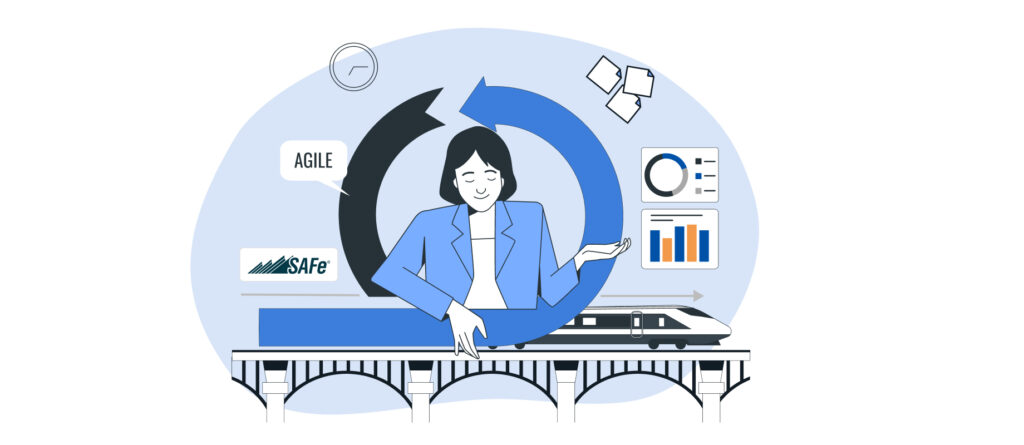
Agility has fundamentally transformed software development in recent years. Methods such as Scrum and Kanban have long been established in many teams. But as soon as multiple teams begin working together on complex products, a key question arises: How can agile principles be scaled effectively?
This is exactly where the Scaled Agile Framework (SAFe) comes in. It offers companies a structured approach to effectively implementing agile practices, even in large projects and organizations. Many of our customers are already using SAFe to coordinate the collaboration of dozens of teams and achieve shared goals.
At IT Sonix, we’re also deeply engaged with this topic. As part of our Circle Agile project implementation initiative, we regularly share experiences, methods, and best practices to further develop agile project implementation in complex environments. Our goal: to deliver products successfully, sustainably, and adaptably—even when they extend beyond team boundaries.
What is SAFe, and why do we need it?
SAFe stands for Scaled Agile Framework and was developed in 2011 by Dean Leffingwell and Drew Jemilo. The framework provides a set of principles, roles, and processes for systematically scaling agile methods—in theory, even to the level of entire enterprise structures.
SAFe makes it possible to apply agile practices even when projects become complex due to the following factors:
- A large number of participating teams
- large organizations with many interdependencies
- Highly Complex Products
This makes SAFe an attractive option for companies where not only a few teams are working, but entire value streams need to be synchronized
The Fundamentals of SAFe
SAFe is based on three pillars that connect it to established agile and Lean approaches:
- Agile Manifesto: Collaboration, working software, adaptability, and customer focus are the core values.
- Lean Thinking: Focus on value streams, continuous flow, and continuous improvement.
- SAFe's core values: Alignment, Respect for People, Transparency, and Relentless Improvement.
This foundation is brought to life through ten agile-lean principles. They range from an economic mindset to short learning cycles, decentralized decision-making, and an organization structured around value streams.
In this way, SAFe provides a clear framework for making agile methods effective not only on a small scale but also on a large scale.
How does SAFe work in practice?
At the heart of SAFe is the Agile Release Train (ART)—a long-term structure in which multiple agile teams collaborate to deliver a value stream. An ART synchronizes the teams' work, creates transparency, and enables a shared focus on goals.
A key tool in this process is the Planning Interval (PI), which typically lasts 8 to 12 weeks. Within this period, the teams plan and coordinate their tasks together. While individual sprints set the pace in Scrum, in SAFe the PI takes on this role for the entire ART. Dependencies between teams become apparent, features are prioritized, and specific delivery timeframes are established.
New roles support this coordination:
- Release Train Engineer as a cross-functional facilitator,
- Product Management for content management,
- System Architect to ensure a common technical direction.
This results in a scaled approach that, in principle, follows the same agile ideas as Scrum—only at a higher level.
SAFe and Agile Transformations
SAFe is more than just a collection of processes—it is often part of a larger agile transformation. In this process, companies face the challenge of bridging two worlds:
- Hierarchies ensure stability and efficiency.
- Networks enable adaptability and a customer-centric approach.
The balance between these two extremes determines whether an organization will be successful in the long term. To shape this transformation, management support, a clear understanding of the purpose of the change, and a willingness to explore new paths are essential.
In our Circle Agile Project Implementation group, in particular, we regularly discuss these challenges: from agile leadership to the use of metrics to various scaling approaches. This ongoing exchange strengthens our ability to support clients as they adopt or further develop agile working methods.
A Critical Look at SAFe
SAFe provides structure and guidance when many teams work together and is used by many large companies. At the same time, it is frequently subject to critical scrutiny: In the age of microservice architectures, dependencies between teams should actually be minimal. Is the need for very close coordination a sign that teams have been structured incorrectly?
This discussion is important because SAFe is not a panacea. It is a tool that works very well in some contexts but may introduce unnecessary complexity in others.
Here at IT Sonix, we understand both the strengths and the limitations of the framework. We use this knowledge to navigate existing systems and provide our clients with expert advice—with the goal of pragmatically improving processes and creating sustainable solutions.
Conclusion
SAFe demonstrates how agile principles can be scaled—from individual teams to programs and across the entire organization. It ensures transparency, highlights dependencies, and establishes a clear rhythm for collaboration.
At the same time, it requires a conscious decision: Not every organization needs SAFe, and not every project benefits from the full implementation level.
We bring extensive project experience and a strong commitment to the table. This enables us to provide targeted support for agile scaling in complex projects. Our goal is to develop sustainable, tailor-made software solutions that create long-term value.