
In agile software development, particularly in Scrum teams, discussions aimed at finding the best possible solution are a daily occurrence. The complexity of projects and the ever-changing requirements of our clients require all team members to possess a high degree of adaptability and strong communication skills. To develop solutions in challenging situations and strengthen collaboration, Scrum Masters often turn to team-building games—not just for fun, but with the goal of bringing about positive change within the team.
The Complex Environment of Agile Software Development
In agile software development, teams operate in a dynamic and often unpredictable environment. At IT Sonix, our teams work closely with our clients’ developers and management to create customized software solutions. Each team operates within a specific context determined by client requirements and the technologies to be implemented. To succeed, Scrum teams must remain capable of taking action despite continuous changes—whether technical, organizational, or interpersonal. However, a team’s ability to function extends far beyond its technical capabilities. It encompasses the ability to work purposefully under changing conditions and to act as a unified whole. This flexibility is an essential component of agile methods and a key factor in long-term project success.
The (Dys)functionalities of a Team
The challenge of keeping a team functional is clearly illustrated in Patrick Lencioni’s model, „The Five Dysfunctions of a Team.“ Patrick Lencioni’s model depicts a pyramid that highlights five key dysfunctions of a team. These dysfunctions—such as „lack of trust“ or „fear of conflict“—can limit a team’s effectiveness. They are contrasted with functional team behaviors such as „trust“ and „openness to conflict.“ In a Scrum team, it is important to recognize these dysfunctions and find ways to address them constructively. Rather than avoiding the dysfunctions entirely, the goal is to raise awareness of them and replace them with functional behaviors in order to gradually improve the team’s collaboration and performance.

This is particularly important in agile teams, as their work is often characterized by short sprints and an iterative approach. Teams that do not allow for constructive conflict and instead cultivate artificial harmony run the risk of avoiding important discussions. This can have a direct impact on the quality of the software and the team’s productivity. However, when conflicts are allowed to arise and are resolved, the team can grow together and achieve its goals more quickly and efficiently.
Why games, specifically, in an agile context?
Our Scrum Masters deliberately use games as a tool in agile teams for the following reasons:
- Play as a Learning Opportunity: Games offer an opportunity to try out new behaviors in a safe environment. They allow participants to step outside their usual roles and adopt new perspectives. Especially in software development, where collaboration and communication determine success or failure, games can help bring about lasting changes in the way team members interact. This experience can lead to a deeper understanding of one’s own role within the team and improve collaboration.
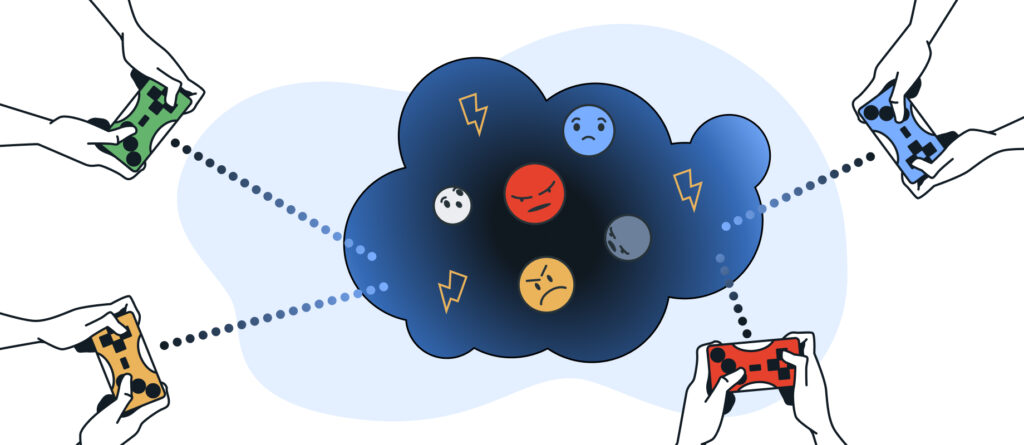
- Games as Simulations: Games can also be used to simulate situations that don’t always come to light in the course of normal daily work. For example, Scrum teams can use role-playing or cooperative games to reenact typical conflicts without the emotional barriers that arise in real-life situations. This fosters a willingness to confront conflict and gives the team the opportunity to test solution strategies in a safe environment. Sometimes, a previously unnoticed real-life conflict may also come to light. The game brings this conflict to light, allowing it to be addressed directly—an important step toward improving the team’s effectiveness. Harmful patterns, such as forced harmony, are broken down, and the team can thoughtfully develop new mechanisms for conflict resolution.
The Role of the Scrum Master in Gameplay
Scrum Masters use team games not only to bring fun into the workday, but also to specifically improve team dynamics. According to the Scrum Guide, it is the Scrum Master’s role to continuously support the team in reflecting on and optimizing its processes. Team dynamics and social interactions play a central role in this. Team games offer an excellent opportunity to bring behavioral patterns to light and to change or reinforce both dysfunctional and functional practices. For example, if a Scrum Master observes that communication within a new team is not yet flowing smoothly, a cooperative game could help remedy the situation. A simple communication game, conducted separately from the actual work situation, can encourage team members to speak more openly with one another and coordinate better. Ultimately, this also improves collaboration in the actual software development process.
Voluntary Participation and Goal-Setting in Play
When introducing games to Scrum teams, it is important to follow the principle of voluntary participation. Learning and personal development only work if all participants take part in the games of their own accord. This becomes particularly clear when language barriers come into play in an international team. For employees who have to express themselves in a foreign language, participating in a game that focuses on language skills can create additional pressure. A good Scrum Master recognizes such situations and ensures that games are used only when they truly offer added value to the team. For a game to successfully contribute to team improvement, it must also have clearly defined goals. A Scrum Master should observe the team’s social dynamics and formulate hypotheses about potential areas for development. A game is then selected that specifically addresses these areas. Only through continuous reflection and adaptation of the methods used can we ensure that games become a useful tool in the agile development process.
Gaming isn't for everyone—and that's okay
There are always team members who don’t want to participate in games. Some find this approach too playful or childish, while others feel uncomfortable in such situations. It’s important for Scrum Masters to take these concerns seriously and understand the reasons behind the reluctance. Even an open conversation about why someone doesn’t want to participate in a game can be a valuable contribution to team effectiveness. It fosters mutual understanding and builds trust—both of which are essential elements for the success of an agile team.
Conclusion: Team Games as a Tool in Scrum Teams
Team games offer Scrum teams a valuable opportunity to enhance their ability to work together and improve team dynamics. Although they are not a panacea, they can provide a crucial boost that leads team members to develop greater trust in one another and collaborate more effectively. Even a short game session can help identify and overcome dysfunctions—thereby laying the foundation for successful collaboration in agile software development.