
The actual origin of the term “virtual reality” cannot be definitively determined. Various sources point to different origins dating back as far as the 15th century. The applications of virtual reality are just as diverse and creative as the theories about its origins. But let’s start from the beginning …
Where does virtual reality actually begin? Even Plato, in his Allegory of the Cave, grappled with the question of whether the world we experience and perceive might not, after all, be nothing more than a shadow play—in other words, virtual reality? If we trace the lineage of Oculus, HTC Vive, and the like backward on the timeline, we arrive at a pictorial frieze in Pompeii dating from 60 B.C.—a circular artwork that completely surrounded its viewers. From the 18th century well into the 19th, circular panoramas served as mass entertainment and a popular pastime—and even today’s VR headsets captivate users primarily through this very feature.
What is virtual reality?


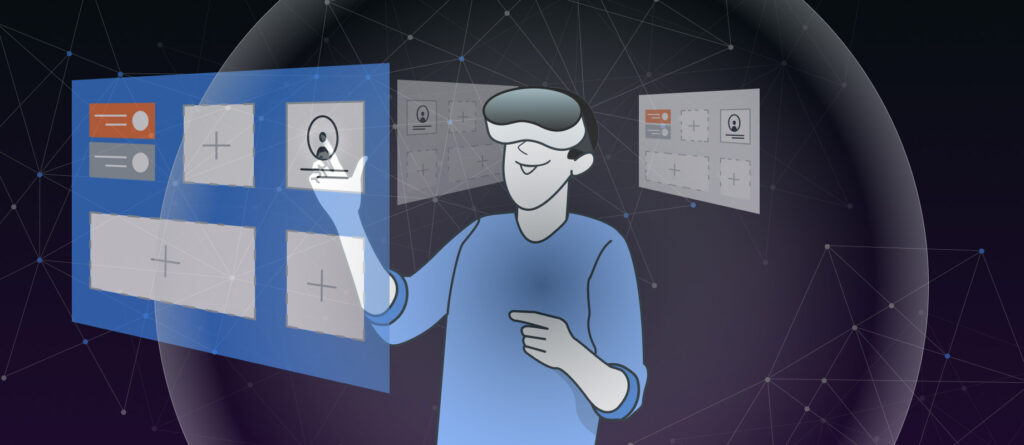
Essentially, VR (Virtual Reality) is a term that, together with MR (Mixed Reality), forms a subcategory of AR (Augmented Reality). AR encompasses all ways of virtually enhancing or expanding reality. While MR blends real and virtual environments, VR focuses on environments that are entirely generated virtually.
The first devices that correspond to our modern understanding of VR were developed in the mid-20th century. These include Morton Heilig’s „Sensorama“ (a film projection system enhanced by olfactory stimuli) and Ivan Sutherland’s „The Sword of Damocles“ (the first „head-mounted display,“ also known as the „Ultimate Display“).
In the 1990s, the video game industry finally began to take its first tentative steps toward integrating VR into its products—a process that continues to this day and is one of the driving forces behind the further development of this immersive technology. While these early products struggled with limited processing power and low resolution, today’s VR headsets—such as the Meta Quest 2—leave little to be desired—were it not for the problem of motion sickness, which previous generations already had to contend with when viewing panoramic images.
Areas of Application
In addition to our games „Konrad’s Kittens“ and „FusionPlayHeroes,“ in which we combine various AR and VR elements to create an innovative gaming experience, we are also currently developing a VR simulation for use in the logistics industry. This simulation is designed to help industrial workers learn skills for assembling equipment and for stacking boxes properly and efficiently. The high-score system integrated into the application allows for the identification and optimization of time-consuming work steps.
A simulation in this field not only offers the advantage of being able to be used from virtually anywhere, but it also eliminates the need to restore the training environments to their original state each time, since this is done virtually and automatically once the task is complete.
However, our test runs with the simulation so far show that difficulties can arise due to the lack of haptic feedback. On the one hand, this distorts important factors (such as speed and endurance) and, on the other hand, can also make users feel as though the experience is unrealistic. Currently, our Xperts are exploring possible solutions to create training environments that incorporate both real objects and mixed-reality elements. This preserves actual interaction while also allowing objects to be enriched with important information and key indicators (movement patterns, speed, etc.) to be analyzed.

Motion Sickness Problem
One issue that our experts also deal with extensively when developing our VR applications is motion sickness. This refers to unwanted side effects associated with the use of VR applications that are similar to motion sickness, such as dizziness, headaches, or nausea. These symptoms often occur because there is a lack of a so-called spatial reference point when interacting with virtual applications.
From a biological perspective, there is also a very simple explanation for the motion sickness problem in VR applications: Our ears contain what are known as semicircular canals—small, fluid-filled tubes that act as a kind of built-in level. For example, if our eyes perceive a forward tilt in a VR application, but we’re actually just standing in the room and not tilting forward, a discrepancy arises because, according to our biological spirit level, we’re standing upright. This causes the symptoms mentioned above in a significant percentage of people.
A teleportation feature—which our Xperts are currently working on—could solve this problem. Using sensors on the hands, you select the point you want to reach in the VR environment and then land gently at the desired location—either by teleportation or by jumping.
How do we work?
When developing our VR products, our Xperts rely on the Meta Quest 2 and Unity’s development tool. With a market share of 40–60 % among well-known indie games, it is an established software platform for creating cutting-edge VR applications. Furthermore, it is significantly more widely recognized in the business sector than, for example, PlayStation VR. However, development does not take place directly on the headset but rather using a PC running C#. This requires Unity’s XR Interaction Toolkit. The content can thus be displayed simultaneously on both the headset and the PC. Furthermore, developing via a PC offers the advantage of a debugging console, which makes it easy to resolve Meta Quest 2 error messages that would otherwise be difficult to handle. With our innovative VR applications, we aim not only to transform our customers’ world but also to positively influence the life-changing upheavals brought about by the digital transformation.
No one can recount what happened over two thousand years ago, and the future cannot be predicted. The only certainty is that developments in VR are still in their infancy and that its areas of application will expand at an ever-increasing pace as time goes on. Even now, there are applications for VR—such as in medicine or logistics—that extend far beyond the entertainment industry and make a valuable contribution to advancing the interests of society as a whole. However, every technological change of this magnitude carries not only positive potential but also risks; therefore, a responsible approach to its development is essential—one that elevates this responsibility to an ethical standard.