
Every year, the International Girls in ICT Day is raising awareness worldwide about the importance of inspiring girls and young women to pursue careers in the tech industry. Despite numerous initiatives, the proportion of women in technical professions remains low—especially in forward-looking fields such as artificial intelligence. The day is intended not only to inspire, but also to highlight the structural barriers women still face in the tech world.
Artificial intelligence is changing our world—but who is actually shaping it? A look at the numbers shows that women remain severely underrepresented in the AI industry. The reasons for this are complex: stereotypical gender roles, a lack of support, and a lack of visibility.
Research also shows that this underrepresentation has consequences—as demonstrated, for example, by the study „Women in Artificial Intelligence: Roles, Realizing Potential, and Corporate Strategies“ of the Fraunhofer Institute. „An algorithm or an AI-based system built on it reflects the perspective of the development team. If a product is developed exclusively by a homogeneous group […], there is a risk of blind spots.“ (Fraunhofer, 2024, p. 7)
These blind spots can lead to biases becoming entrenched in AI systems—with far-reaching consequences. „Diverse teams—or a reduction in the underrepresentation of women—can have positive effects, not least because a variety of perspectives makes it easier to identify existing biases in AI models.“ (Fraunhofer, 2024, p. 16)
The good news: Change is possible. „The active involvement of women strengthens technological integrity and helps overcome biases, which can lead to fairer and more inclusive AI-based systems.“ (Fraunhofer, 2024, p. 4) More and more companies are recognizing that diversity is not only fair—it is also a driver of innovation.
Source: Cristescu, A., Omri, S., Ködel, L., Schletz, A., & Marsden, N. (2024). Women in Artificial Intelligence: Roles, Realizing Potential, and Corporate Strategies (K. Hölzle, O. Riedel, W. Bauer, B. Bienzeisler, & J. Neuhüttler, Eds.). Fraunhofer Institute for Industrial Engineering IAO.
As an IT company, we, too, are aware of this responsibility. Women work in all areas of our company and hold key roles there. We are particularly proud of the high proportion of women in leadership positions, who shape our technological development with their professional expertise, team spirit, and fresh perspectives. For us, promoting diversity and equal opportunity is not a side issue, but an integral part of our corporate culture.
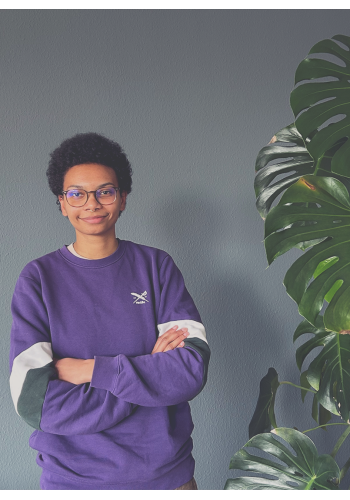
In this post, we want to find out: What does it actually take to get more women excited about the AI industry and bring about structural changes in the long term? That’s exactly what we asked Amelie, who works as a student employee in our Data Science department and shares her experiences as a young woman in this exciting but often challenging field.
What made you decide to pursue a technical degree?
Even back in high school, I was particularly interested in the technical subjects. Later on, I realized that social issues are very important to me. That’s why I wanted to combine topics where technology and people intersect. Over time, I discovered more and more points of intersection between the two and realized that that’s exactly where my interest lies.
Was AI your area of interest from the very beginning, or did that develop later on?
The connection to this topic didn't become clear to me until later. During my studies, I first came into contact with algorithmic bias in a summer seminar—that’s what sparked my interest. When I saw the job posting, that’s when the connection really clicked for me for the first time, and I could imagine working in this field. I’ve also come to realize that working in this field requires a lot of self-motivation, because you often have to figure things out on your own and stay on top of things. But that’s exactly what makes it so exciting.
What are you currently working on? Can you give us a brief overview of your responsibilities?
I’m currently working at IT Sonix on a chatbot that accesses our internal information sources, enabling our employees to ask specific questions about company-related topics. My responsibilities are very diverse: On the one hand, I’m continuing to develop the RAG pipeline in Python; on the other hand, my work also includes research and evaluation tasks—for example, to find suitable models or tools. At the same time, I’m also working on the front end, using various AI tools. Another exciting part of my work in the future will be deployment—that is, rolling out the chatbot so it can actually be used within the company.
Is there a project or challenge you're particularly proud of?
I don’t have one big project, but that’s exactly what I like about it. I’m constantly learning lots of little things, and as a result, I’m seeing real progress—both in my work and in my own skills. For example, a special milestone for me was when I set up an API with a database for the first time.
As a woman, what is your experience of the work environment in the tech industry—and do you still see any particular challenges for women there?
That’s a pretty complicated question because it has so many layers. For me, one of the most exciting aspects lies at the intersection of my studies and my job. I find working at IT Sonix enjoyable, despite the very high proportion of men—especially because of people like Danny, who is very open-minded. That makes it easier for me to contribute. At the same time, I realize how much the work depends on good collaboration. It’s often different in college. Alternative perspectives are often missing there. I think computer science is far too often seen as a purely technical discipline, even though it clearly has social implications as well. That’s why it’s important to me that groups that don’t fit the norm are consciously given more space—and that an environment is created in which everyone can truly feel comfortable and thrive. At IT Sonix, I get the impression that respectful interaction isn’t just desired, but is actually put into practice.
Do you have any role models or people who have inspired and motivated you along the way?
I am particularly inspired by the work of Dr. Joy Buolamwini, who focuses intensively on discrimination caused by algorithms and AI systems. Her research shows how important it is to critically examine technological developments. But I also find inspiration in my day-to-day work—for example, from Danny, whose motivation and openness are simply contagious.
How do you see the future of AI—are there any trends or developments you’re particularly excited about?
I find it fascinating to observe how AI is transforming software development—especially through agent-based AI, which is increasingly capable of performing tasks on its own. Even now, it’s almost routine to use AI-powered tools when programming. At the same time, I’m curious to see how AI will integrate into everyday and public life in the future, and how it will transform and automate processes. It’s particularly important to me that the use of AI is communicated openly and transparently so that potential risks and security vulnerabilities can be identified and avoided early on.
What advice would you give to young women who are considering a career in IT or AI?
I would definitely encourage others to explore this field—simply because it’s an incredibly interesting area where you have plenty of room to work independently and put your own ideas into practice. There are many women who serve as successful role models in this field, even if they aren’t in your immediate circle—it’s important to keep that in mind. And most importantly: mistakes are part of the process. They’re normal and often exactly what makes you stronger in the long run.