
Innovation is the key to progress—this is especially true in the IT industry. The annual Innovation Day invites people to explore new ideas, technologies, and ways of thinking. Around the world, this day highlights the importance of innovation—whether in science, technology, or society.
Innovation also plays a central role at IT Sonix: It is part of our way of working and shapes how we develop innovative solutions for our customers. On Innovation Day, we worked with our Managing Director Artur Schiefer as well as Dr. Danny Hucke, AI Circle Lead and Scientific Advisor joined us to discuss the importance of innovation. Together, they share their perspectives on the concept of innovation, the IT industry, and the future of technology.
Question: What does innovation mean to you personally?
Artur: To me, innovation means looking at an issue from a new perspective. It’s about answering familiar questions in a different way and, in doing so, making the world a better and simpler place in various areas. Of course, in the traditional sense, it also means further developing products and making them even more appealing to the market.
Danny: I would describe innovation as the ability to evolve in a direction that was previously unknown—to break free from existing structures and reshape things. It’s about creative, original thinking, about blazing new trails and solving problems in a completely different way.
Question: What does innovation mean for an IT company in Central Germany?
Artur: In short: We must be innovative. Our collaborative customer relationships require us to do more than just act as a service provider; we must also take the lead with our own ideas and suggestions. It’s not just about implementing a project, but about executing it in the best possible way. Over the past two years, the topic of artificial intelligence (AI) has come to the forefront in particular. Anyone who wants to keep up in the industry must engage with AI and adapt their processes so that its use—based on reliable data—also makes economic sense. To this end, we have established our own AI task force and also benefit from our close ties to the scientific community. This helps us make the best possible use of AI technologies both for our own software development and for our clients. It is important to us to discuss this topic with our customers on an equal footing so that we can find meaningful solutions together.
Question: What role does a technological edge play in the industry?
Artur: As an IT company, we have the advantage of being able to test, evaluate, and adapt new technologies from Silicon Valley sooner than others. In practice, however, we often find that it takes some time for innovations to truly gain widespread adoption in the market. When we try out such technologies early on and implement them successfully, it gives us a clear advantage as a company and in winning new business. Furthermore, as a software development service provider, we operate at a very early stage in the innovation process. We don’t customize off-the-shelf products; instead, we develop custom solutions that don’t yet exist in this form. Our work is therefore innovative by definition. There is no off-the-shelf software that does exactly what our customers need—which is precisely why they choose us. To live up to this standard, we must also remain open to new technologies and developments ourselves.
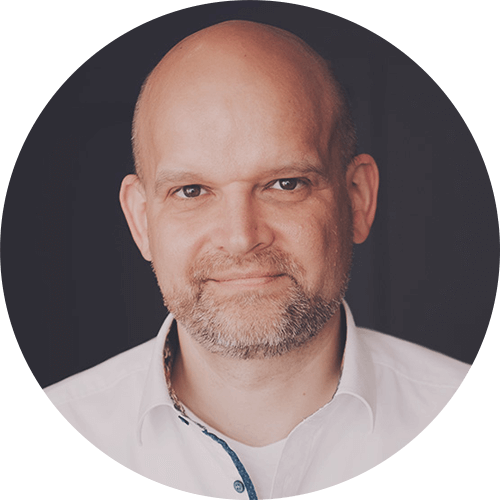

(From left to right: Artur Schiefer, Managing Director, and Dr. Danny Hucke, Circle Lead for AI and Research Advisor)
Question: Innovation means change. How do you handle that internally?
Danny: From an external perspective, innovation gives us, as a company, a competitive edge when we quickly adopt new technologies. But internally, this isn’t always a given. After all, some of the people working here are satisfied with tried-and-true processes and ways of working. That’s why it’s crucial to actively engage our teams, spark their curiosity, and foster openness to new ideas. There are many opportunities, particularly in the field of AI: When certain tasks are automated or accelerated, it frees up time for more strategically important issues. But this transformation will only succeed if employees recognize the added value it brings to their own work.
Question: What structural requirements must a company meet to remain innovative?
Artur: We have made targeted adjustments to our corporate culture to give our employees more freedom to pursue their own interests and ideas outside of day-to-day business. Innovation doesn’t happen at the push of a button or through pressure from above—it must come from within the company itself. This requires an environment that empowers and encourages employees to try new things. It’s about staying alert, testing trends in small projects, and then assessing what concrete benefits they bring to our work. Innovation isn’t an end in itself—it must offer real added value.
Question: What innovations interest you personally?
Danny: Without a doubt, artificial intelligence—especially generative AI. We’re currently witnessing machines that can not only understand our language but also respond to it in meaningful ways. This is an entirely new dimension, because until now, human communication was something we considered unique. AI can now not only generate text, but also write programs on its own, create images, and even support creative processes. What’s fascinating is that we’re still just at the very beginning. Development is proceeding exponentially, and we have no idea yet just how far-reaching the upheavals will be in the coming years. For me, it’s clear that we’re dealing with a disruption on the scale of the Industrial Revolution. This technology will not only optimize work processes but also transform fundamental structures in business, science, and society. That’s why I’m deeply engaged with this topic both professionally and personally—because it’s one of the most defining developments of our time.
Artur: What fascinates me is that progress never stands still and things keep evolving in unexpected directions. When I was studying computer science, the Internet was still in its infancy—no one could have imagined what a central role it would one day play in our daily lives. It was similar with the smartphone: initially just a cell phone with a touchscreen, it has since sparked an entire digital revolution. Now, with AI, we’re facing another development like this. Danny already mentioned it: this technology will drastically change our daily lives—we just can’t say exactly to what extent yet. But one thing is certain: the digital transformation continues. I’m curious to see what the future holds, and I’m looking forward to helping shape these developments as part of IT Sonix. Our goal is not only to support these innovations but to actively drive them forward, thereby making the world a little bit easier and better.